Case Study
Creating Lasting
Learning Habits
Designing a service ecosystem that enables HPI Academy trainees to translate learning goals into lasting habits through gamified practice, peer reflection, and mentor guidance.

Context
Hasso-Plattner-Insitute Academy (d-school) is one of Europe’s leading institutions for Design Thinking education and corporate innovation programs. A recurring challenge is that participants often struggle to apply newly learned methods sustainably in their daily work. I collaborated with the Corporate Innovation and Leadership team at HPI Academy to deeply understand this problem and design human-centered solutions that support lasting learning and practical application.
Project Partner
HPI Academy
Duration
+6 months
Topics
Strategic, Service & UX Design
Role
Strategic Designer
My Role & Process
My role as a Strategic Designer was to explore the problem and solution spaces holistically, connecting user needs, business requirements, and system
perspectives:
- Led in-depth research to uncover actionable user insights (20+ Interviews)
- Translated insights into clear opportunity areas and strategic directions
- Drove iterative ideation and prototyping to validate and converge on the best solution (3+ Workshops)
- Defined implementation strategy (branding, service blueprint, roadmap, business model) for scalability and fit
- Delivered a validated concept and strategic framework to HPI Academy for implementation
Problem Statement
- The Gap Between Learning and Doing
Coaches often have limited influence on this process, leaving participants without adequate support for the learning transfer after trainings. Resulting in a lower overall impact of training programs.
- Missed ROI: Training Without Application
Organizations invest heavily in training methods like Design Thinking, but the newly learned skills rarely become part of routine workflows.
Challenge
Empowering participants to confidently apply new skills in their daily work.
Core tension:
- Bridging the gap between learning and doing
- Fostering measurable progress, and equipping coaches and peers to support lasting behavioral change.
Research & Insights
Goal of the Research Phase
Build a deep understanding of participants’ and coaches’ experiences to uncover systemic barriers and opportunities for effective learning transfer.
Methods used
→ Desk & Literature Research – established theoretical foundation
→ User & Expert Interviews – gathered perspectives and pain points
→ Guerrilla Research & Cultural Probes – explored trainee experiences
→ Affinity Mapping – identified patterns and insights
→ Insights Synthesis – informed human-centered design decisions
Key Insights
Learning fades without integration into daily routinesNew methods are quickly overridden by time pressure and existing habits.
Confidence requires reinforcement, not just knowledgeWithout feedback and reassurance, applying new skills feels risky.
Transfer is the real challenge—not retentionUsers struggle to recognize when and how to apply knowledge in new situations.
Core inisght
Learning fails without progress visibilityWithout visibility into progress, challenges, and application, neither learners nor supporters can reinforce behavior change effectively.
Strategic Direction
Goal of the Phase
Transform research insights into actionable opportunity areas by identifying pain points, refining the problem, and defining user needs, creating a foundation for ideation and design.
Methods used
→ Stakeholder Mapping - Understanding relationships, roles, and influence between stakeholders.
→ Personas & POV - Clarifying user needs, motivations, and perspectives.
→ Creating HMWs and H2 questions - Reframing insights into actionable problem statements and guiding focused ideation
→ System Mapping - Revealing connections, dependencies, and systemic pain points.
→ Opportunity Fields - Identifying high-impact areas for design intervention.
Selected Deep Dives
Deep Dive: From System Mapping to Strategic Opportunities
Approach
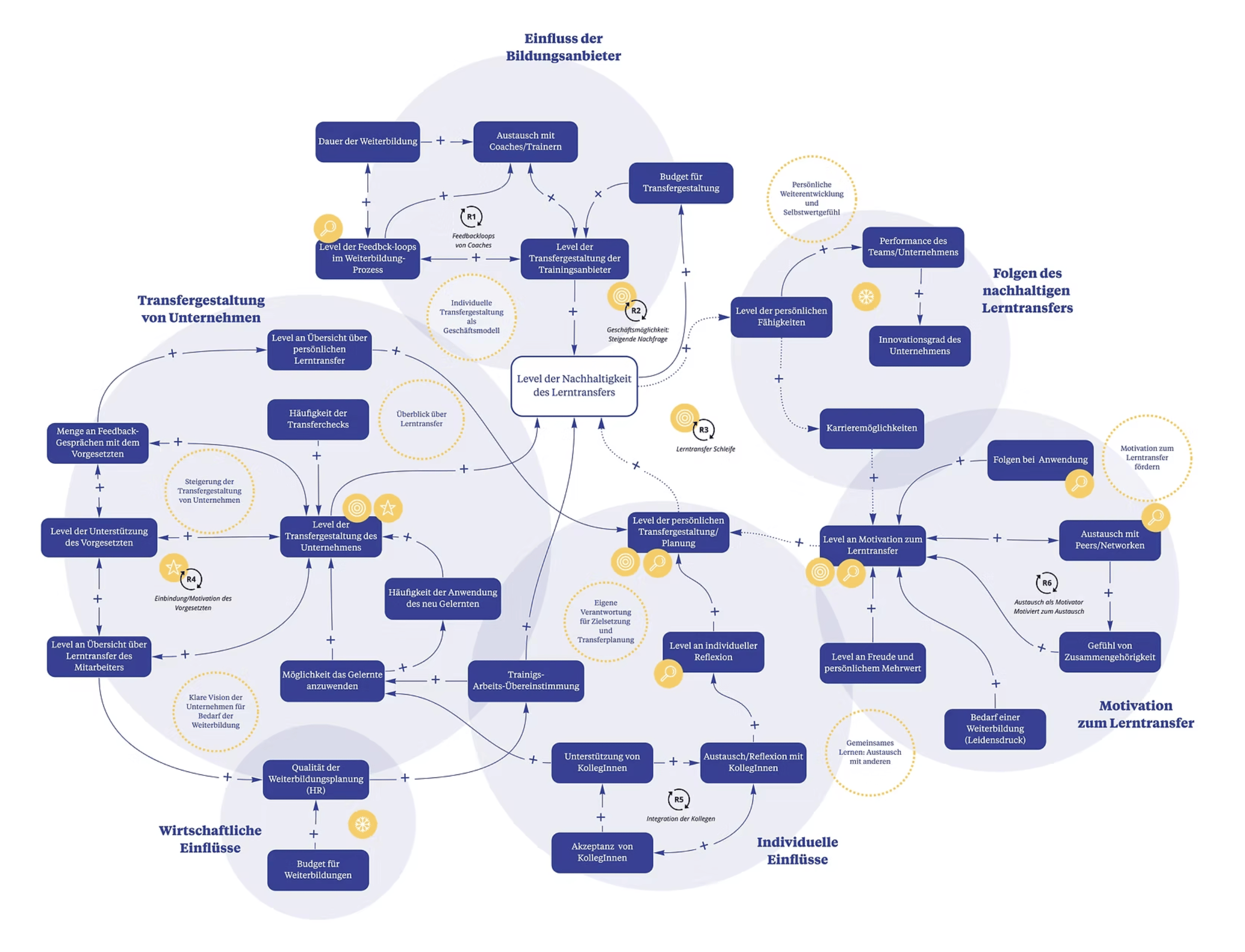
I synthesized research insights into a system map to understand how different factors influence learning transfer. By translating insights into system elements, mapping dependencies, and identifying reinforcing and inhibiting feedback loops, key relationships and leverage points, ripple effects and opportunities for change across the learning journey became visible.
These leverage points represent areas where small interventions can create disproportionate positive impact on the overall system.
Fig. System Map

Impact
System mapping uncovered how interconnected variables shape learning transfer, enabling the identification of leverage points to drive meaningful systemic change.
- Identified reinforcing and inhibiting feedback loops across the learning journey
- Shifted the focus from individual behavior to organizational and contextual factors
- Provided a shared model to align stakeholders on the problem space
Enabled the translation of insights into strategic opportunity areas...
Strategic Opportunities
- Strengthen organizational support for learning transferHelp companies actively guide and reinforce employees’ application of new skills.
- Promote personal ownership of learning outcomesTrainees want to change old habits, but without feedback or reassurance, applying new skills feels risky—leading them to fall back on familiar routines as confidence fades.
- Increase motivation and visibility of learning transferProvide tools that keep learners engaged, track progress, and make transfer efforts transparent for both employees and supporters.
- Position effective transfer as a competitive advantageOffer solutions that bridge learning and practice, enabling organizations and training providers like HPI Academy to stand out in the market.
Concept Development & Validation
Goal of the Phase
Explore and develop solution directions based on research insights, and converge on the most promising concept through structured evaluation. Transform research insights into actionable opportunity areas by identifying pain points, refining the problem, and defining user needs—creating a foundation for the final service and product design.
Methods used
→ Multiple Ideation Workshops - Expanding the solution space from quantity to quality
→ Concept Development - Translating ideas into structured, tangible concepts
→ Concept Evaluation & Prioritization - Identifying the most relevant and promising direction
→ Service Blueprint – Visualizing the end-to-end service experience across touchpoints and stakeholders
→ Paper Prototyping – Quickly testing ideas and user flows at low cost
→ Low / High Fidelity Prototyping – Iteratively refining interaction and usability
→ User Testing of Iterations – Validating and improving concepts based on user feedback
Selected Deep Dive
- Deep Dive: From Ideas to Concept Directions
Approach
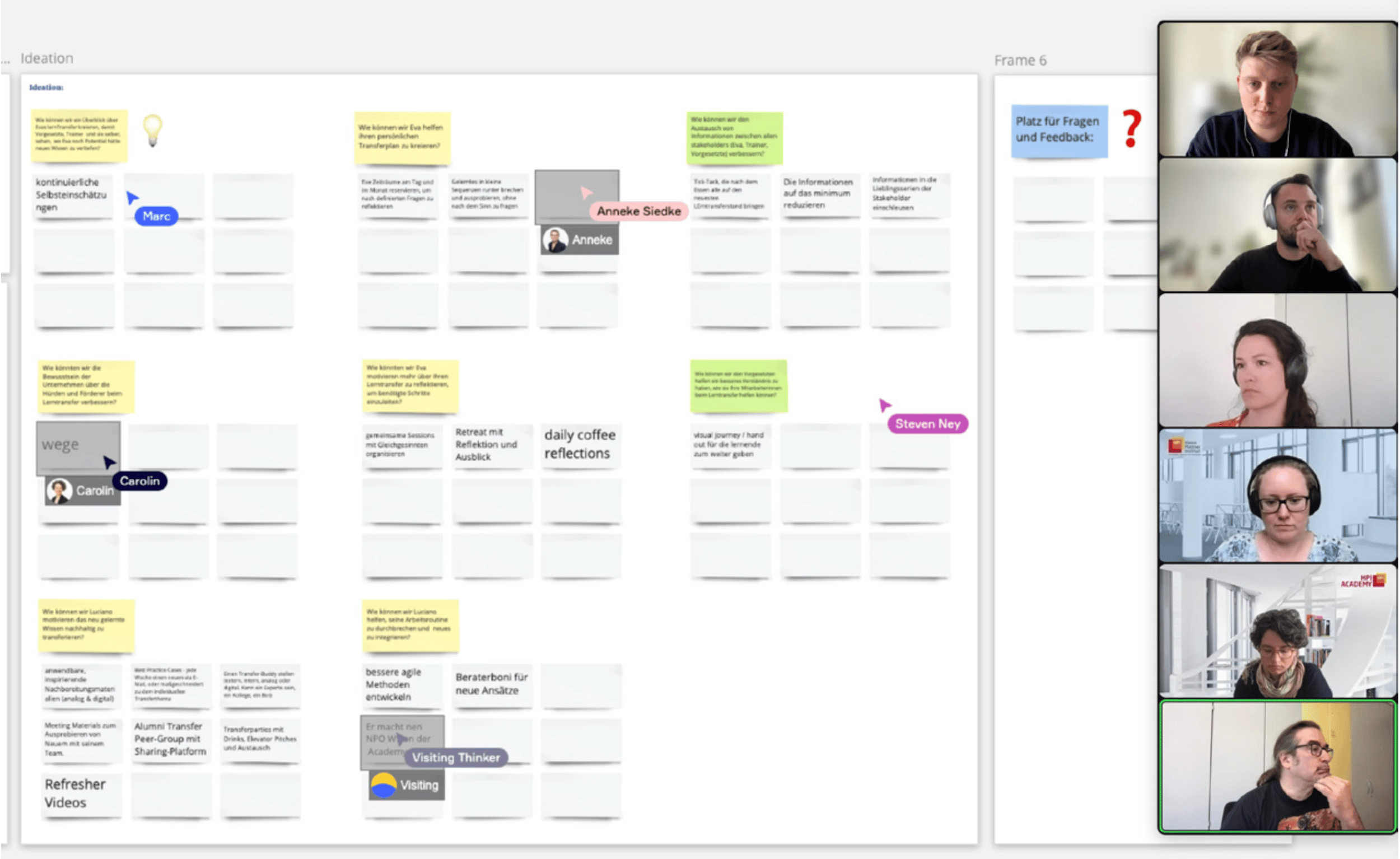
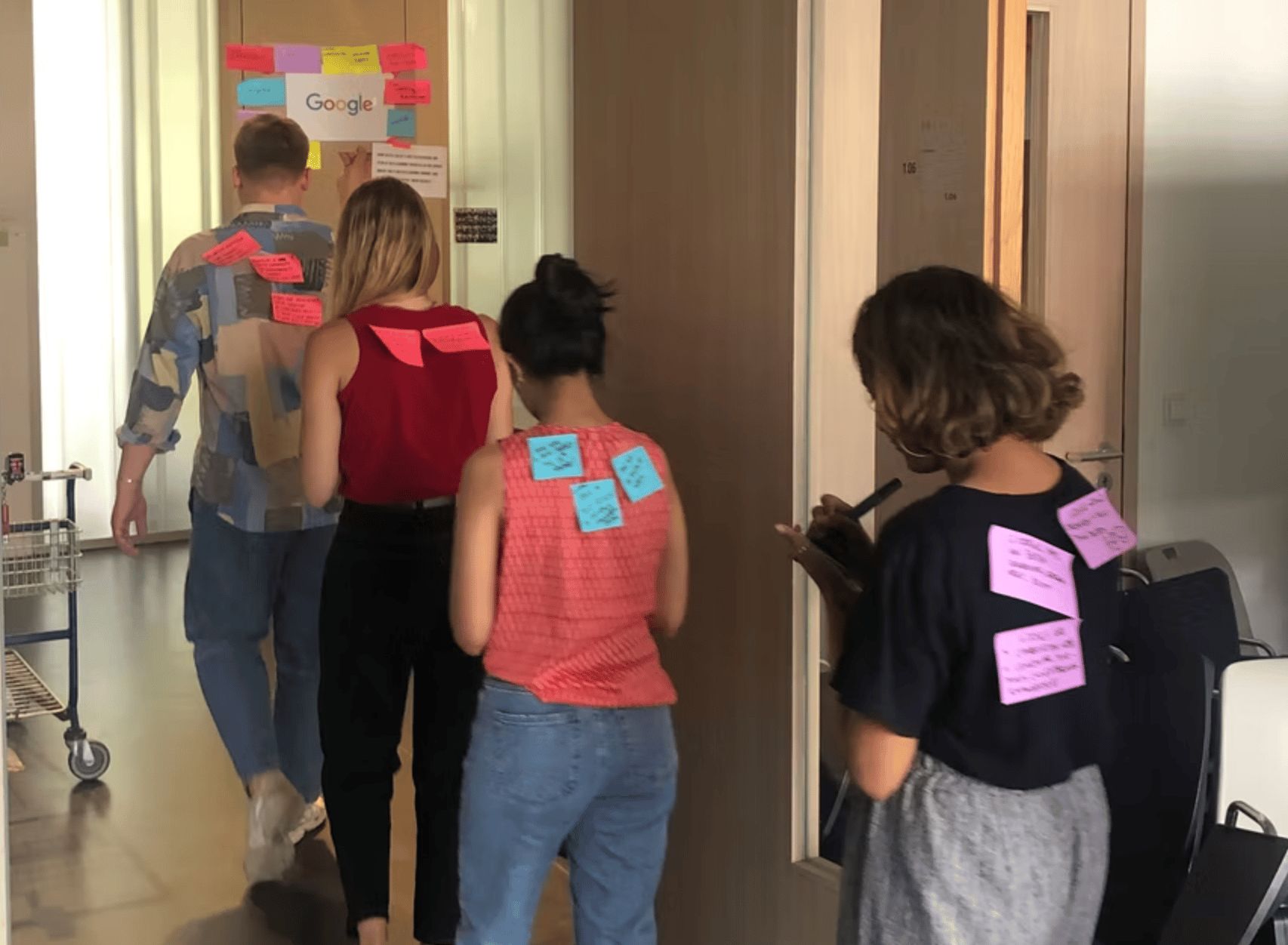
I facilitated ideation workshops with users and HPI coaches to explore open opportunity spaces with no established solutions. Building on personas and “How Might We” questions, I guided divergent thinking through collaborative ideation methods, synthesized outcomes into nine concept directions, and facilitated prioritization to identify the most promising path forward.
Impact
The structured ideation and evaluation process transformed a broad set of ideas into focused, validated concept directions with clear potential for impact.
- Expanded the solution space beyond obvious ideas
- Integrated diverse perspectives from coaches and users early on
- Translated ideas into tangible concepts
- Enabled structured, criteria-based decision-making
- Deep Dive: From Service Blueprint to Tested Solution
Approach
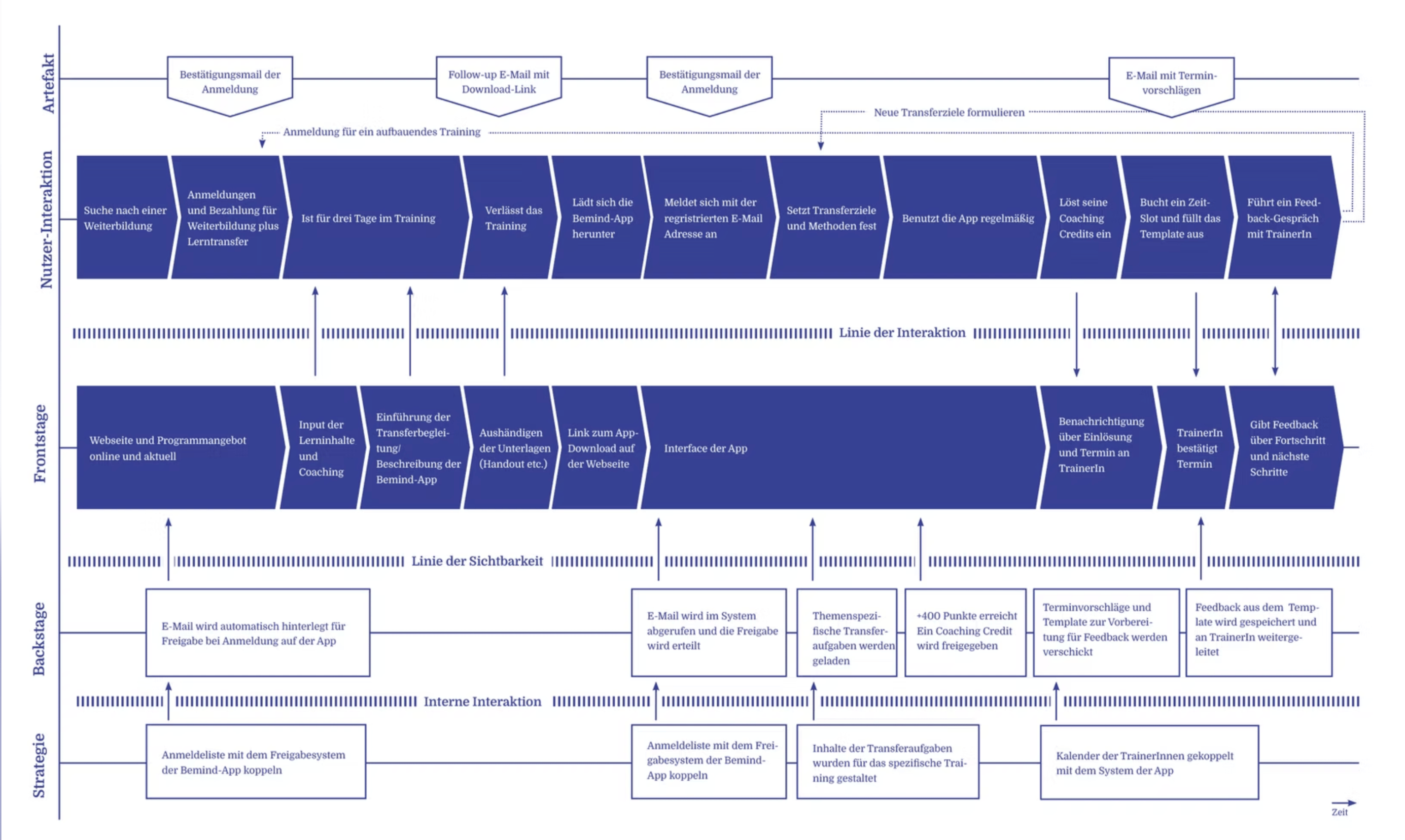
I translated the most promising concept into a service blueprint to map the end-to-end experience across stakeholders and touchpoints. In parallel, I developed and iteratively refined application prototypes — from low-fidelity paper flows to higher-fidelity interactions — to validate usability, user flows, and the overall experience.
Impact
By combining service blueprinting with iterative prototyping, the solution was tested both on interaction and system level—ensuring it works across touchpoints and stakeholders.
- Made abstract concepts tangible and testable
- Validated key assumptions with real users and ensured the solution works across the full service ecosystem
- Identified usability issues early and iteratively improved the design
- Increased confidence in the final design direction
During concept development and validation, two key insights emerged...
Key Insights
Engagement depends on continuous access and interactionUsers value the ability to track progress, access services, and connect with others in one place.
Core inisght
Learning needs a central, always-accessible touchpointUsers rely on a single, accessible entry point to engage with the ecosystem—enabling progress visibility, ongoing interaction, and connection to support.
The Solution
Enabling Sustainable Learning Transfer through Service Design
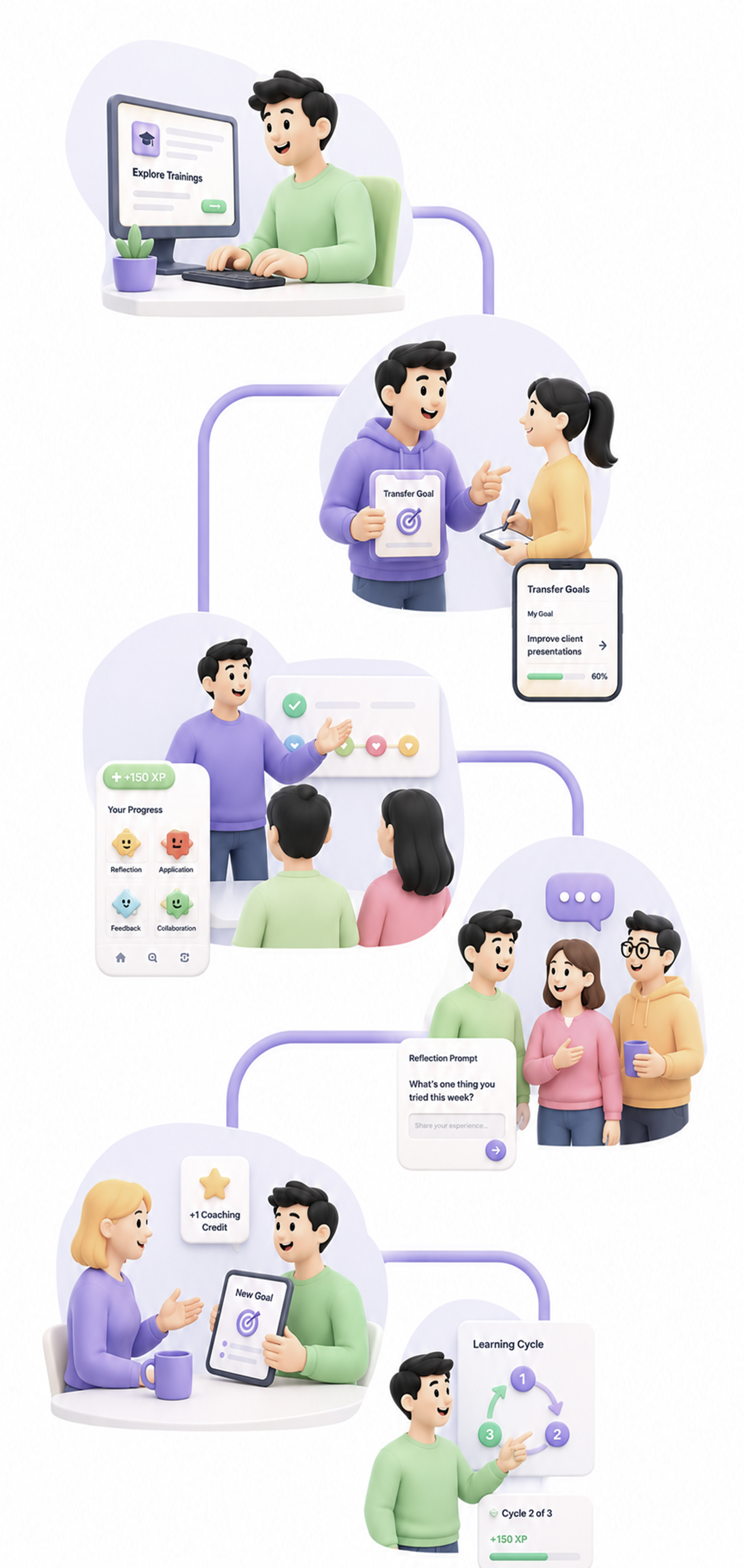
The service is designed as an end-to-end learning journey, guiding participants from selecting the right training to continuously applying and reflecting on new skills in their daily work:


Discover the right training — designed for transfer

1
After the training - commit to a goal that matters
2
Activate learning through gamified practice
3
Make progress visible through shared reflection
4
Reinforce growth through coaching and iteration
5
Learning is not a phase — it’s a system
∞
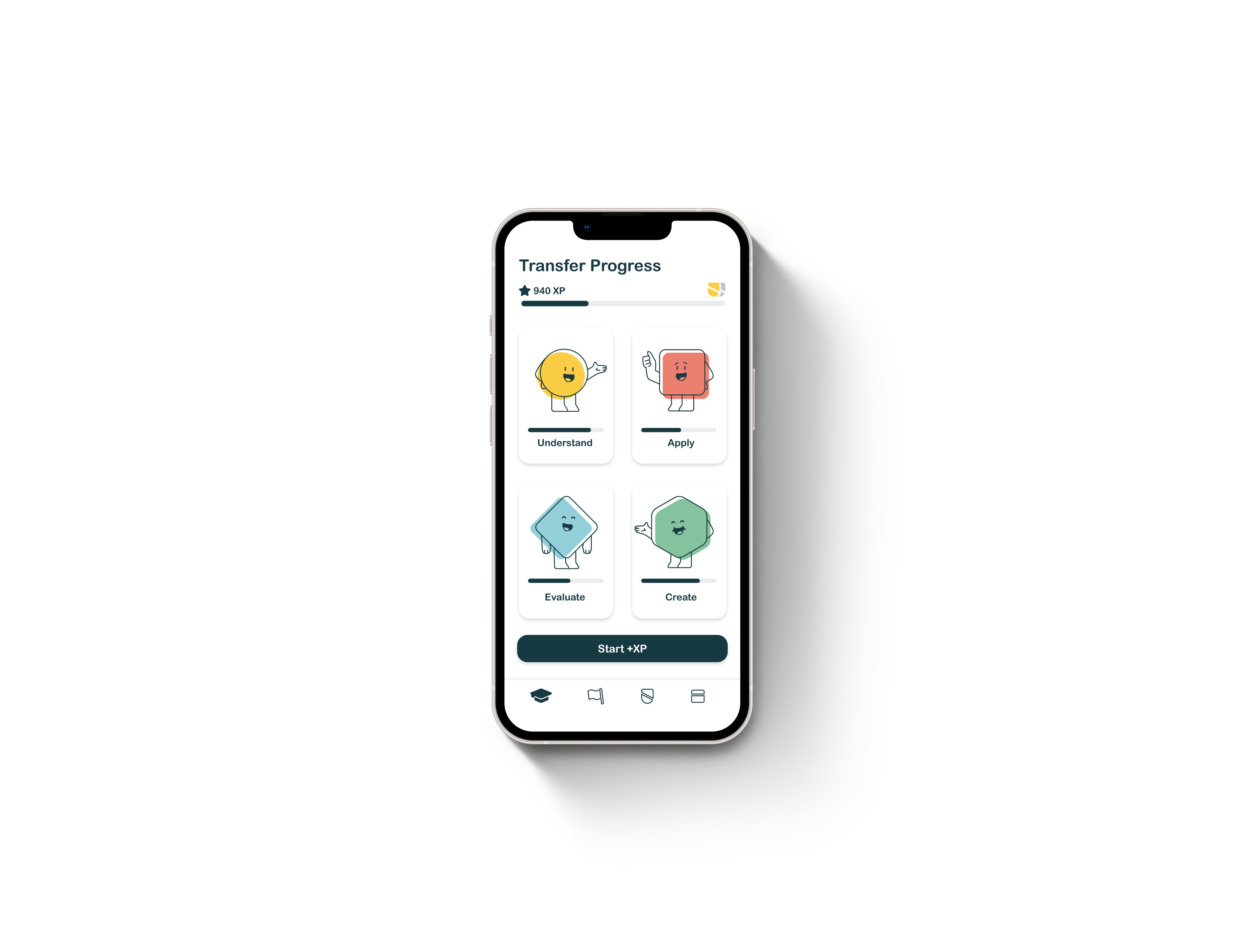
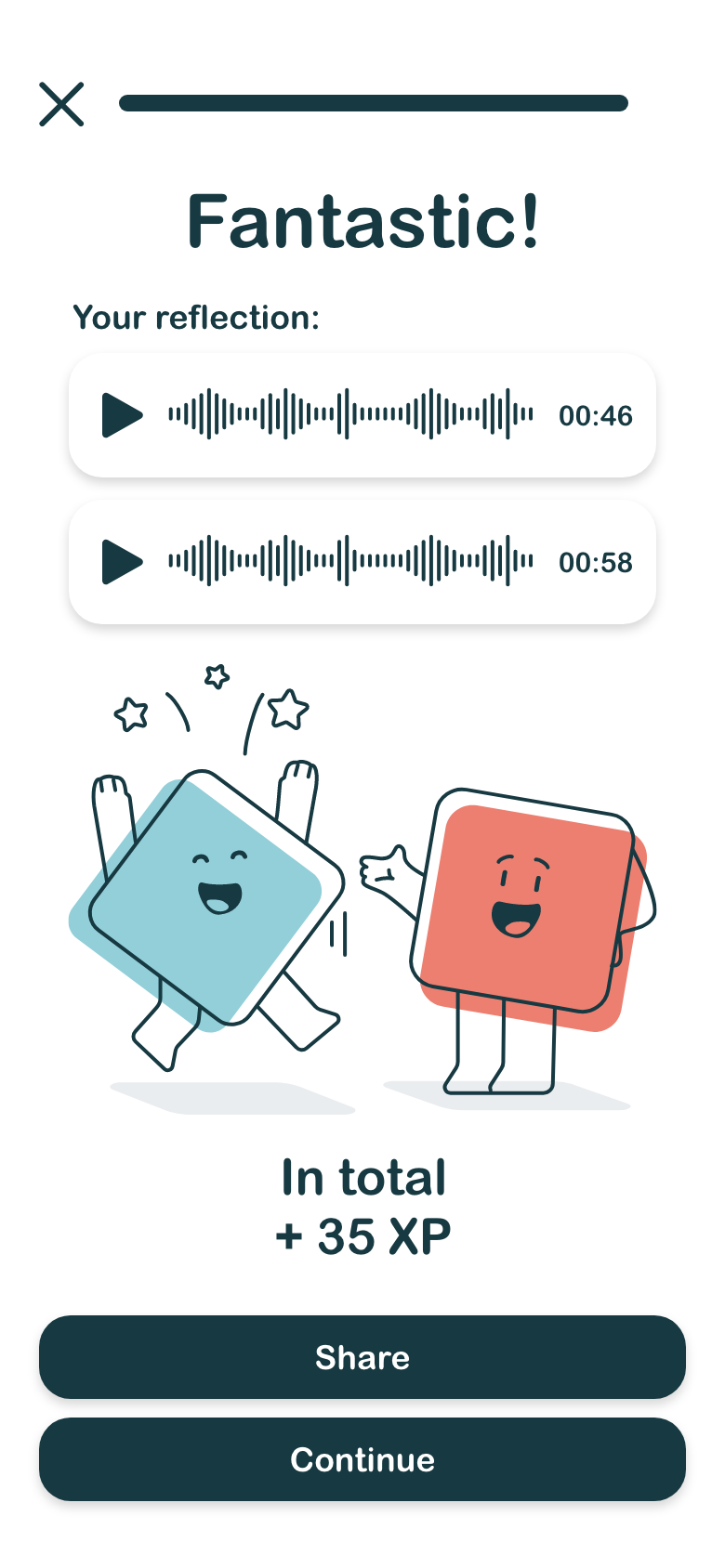
+ The App: An All-in-One Platform for Learning Transfer
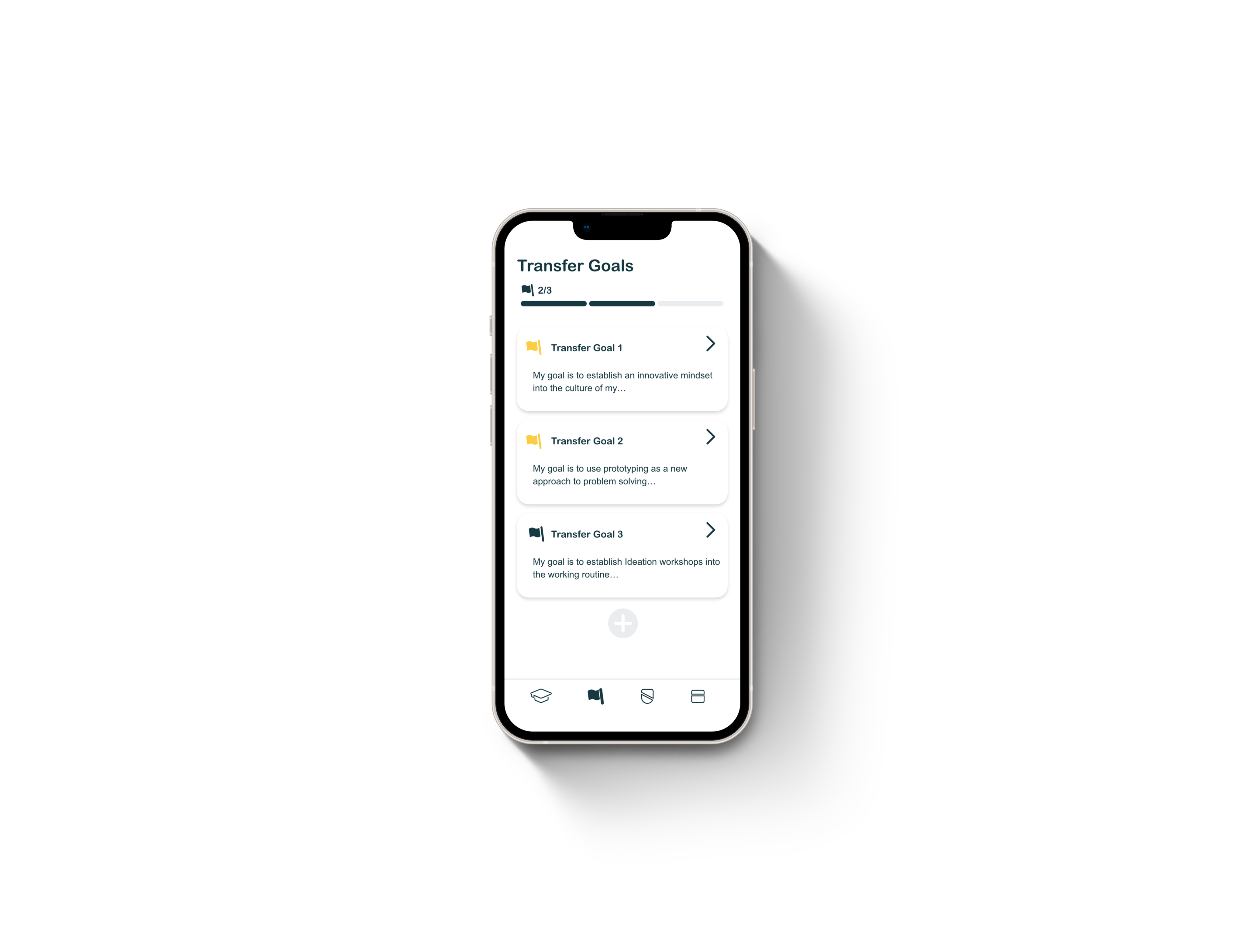
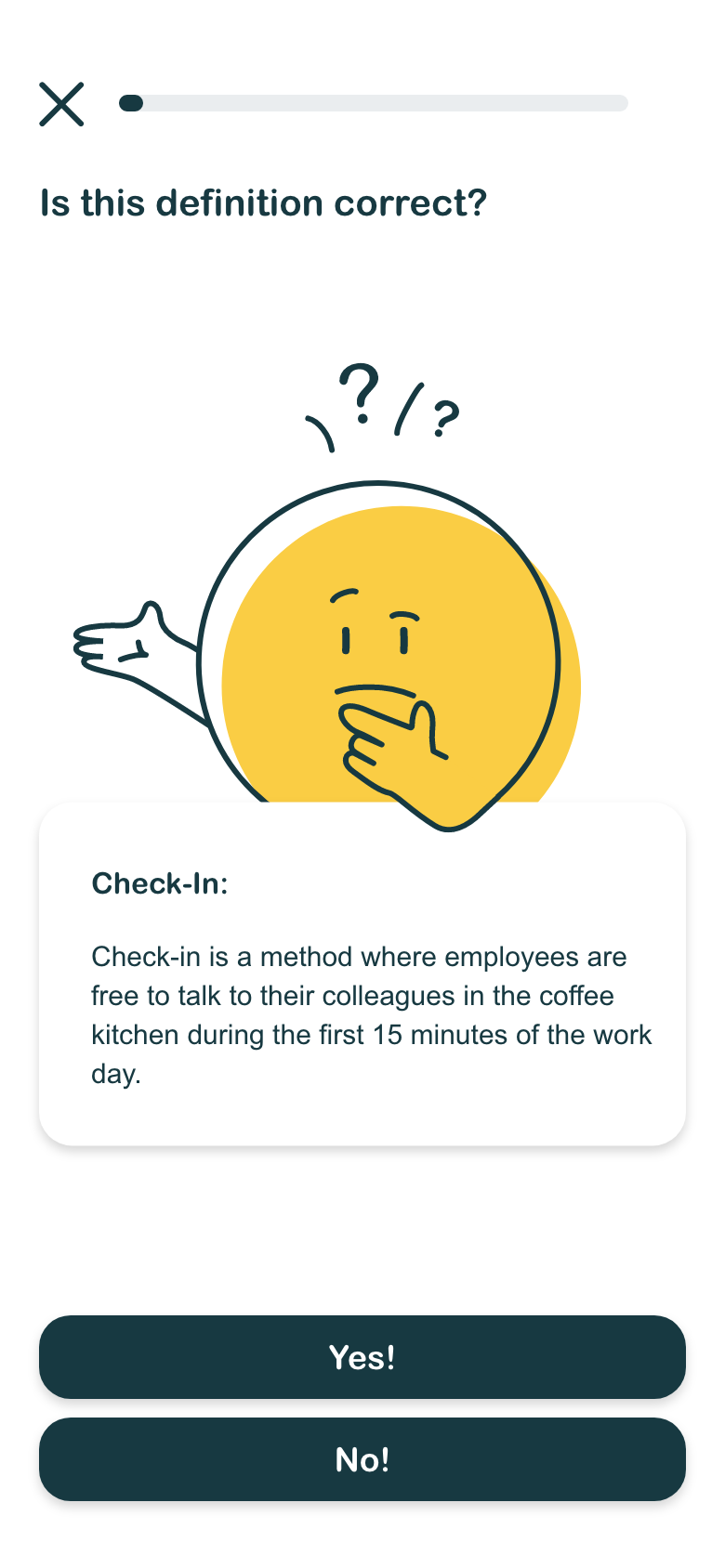
A platform designed to extend learning beyond training by embedding it into everyday work. Through personalized tasks, gamification, and structured reflection, it supports users in understanding, applying, and sustaining new skills over time.
Implementation Planning
Goal of the Phase
Translate the solution into a scalable and feasible service model by aligning user needs, business goals, and operational requirements.
Methods used
→ Vision & Mission Statements– Visualizing the end-to-end service experience across touchpoints and stakeholders
→ Branding & Design System – Quickly testing ideas and user flows at low cost
→ Road Map – Iteratively refining interaction and usability
→ Business Model Canvas – Validating and improving concepts based on user feedback
Selected Outcomes
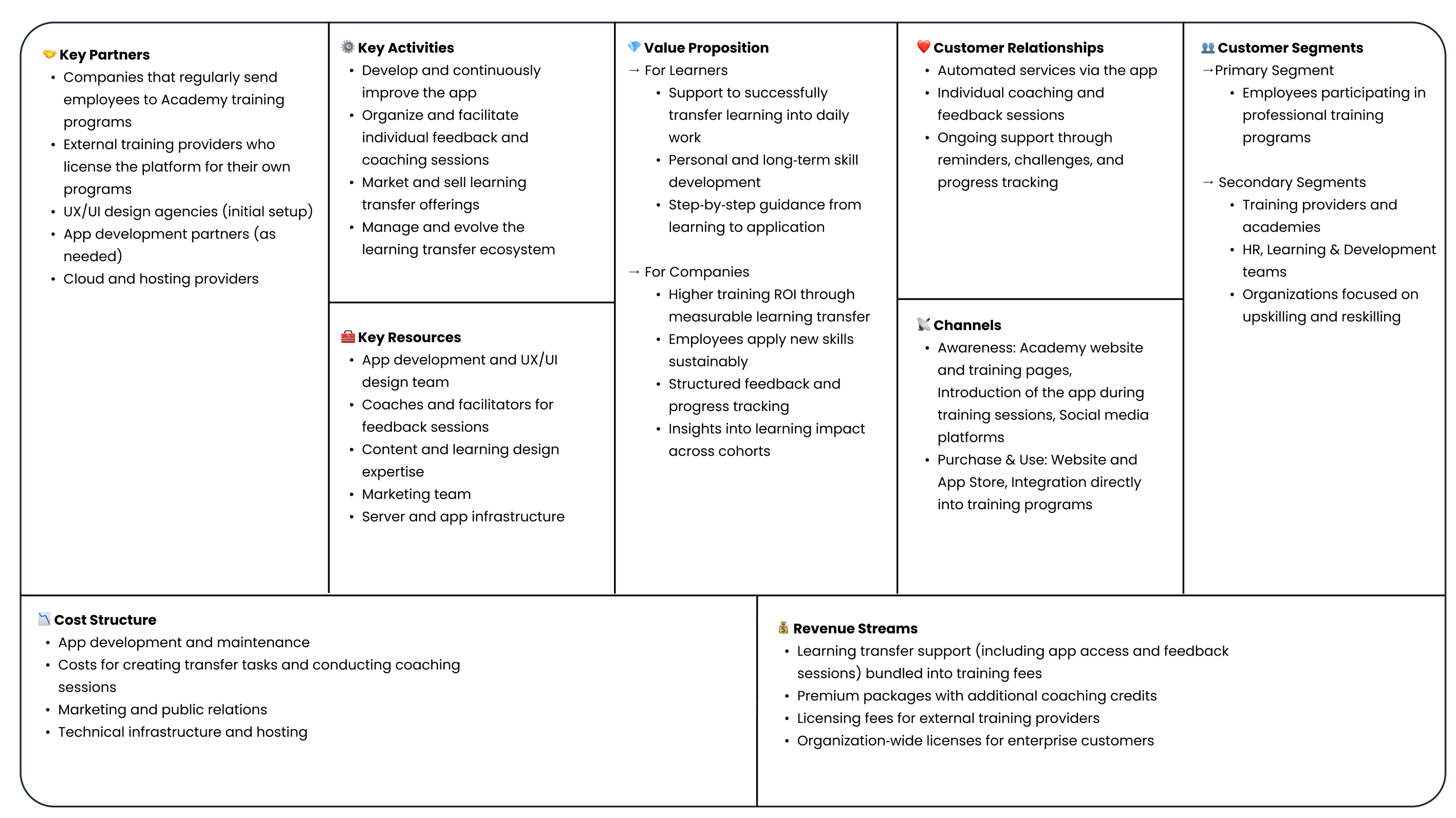
- Business Model Canvas
Defined how the solution creates, delivers, and captures value across stakeholders—ensuring alignment with business goals and long-term viability.
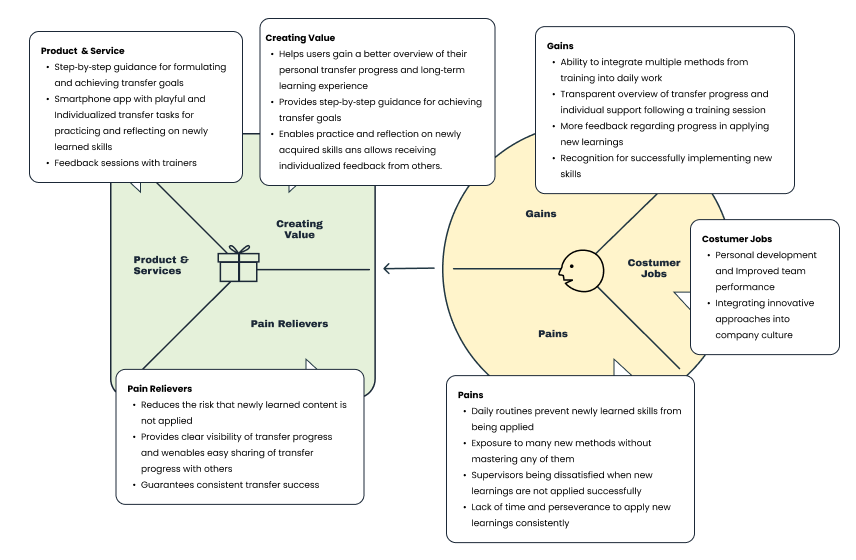
- Value Proposition Map
Mapped user needs, pains, and gains to define a clear and relevant value proposition—ensuring the solution addresses real user problems.
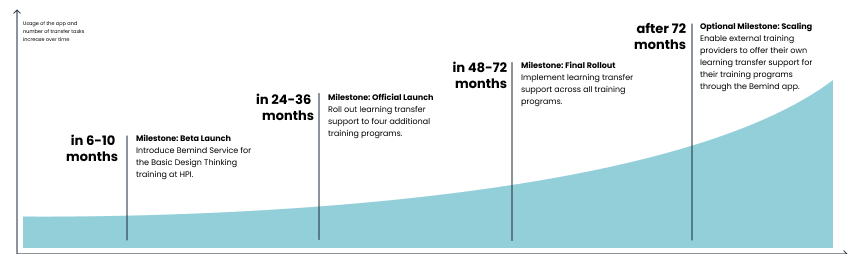
- Roadmap
Defined a phased roadmap from pilot to scalable product—ensuring a clear path to implementation and growth.
Impact
Turned the concept into a structured, stakeholder-aligned plan—enabling HPI Academy to evaluate feasibility, align internally, and move toward implementation.
- Ensures the solution is viable and aligned with business and organizational goals
- Ensures the solution addresses real user needs and delivers meaningful value
- Provides a clear path to implementation, enabling structured execution and scalable growth
Final Impact
Turned the concept into a structured, stakeholder-aligned plan—enabling HPI Academy to evaluate feasibility, align internally, and move toward implementation.
Reflection
Learned to design for systems and behavior change, not just individual touchpoints.
Next
Pilot the solution and validate long-term impact in real-world use.
Case Study
Creating Lasting
Learning Habits
Designing a service ecosystem that enables HPI Academy trainees to translate learning goals into lasting habits through gamified practice, peer reflection, and mentor guidance.
Context
Hasso-Plattner-Insitute Academy (d-school) is one of Europe’s leading institutions for Design Thinking education and corporate innovation programs. A recurring challenge is that participants often struggle to apply newly learned methods sustainably in their daily work. I collaborated with the Corporate Innovation and Leadership team at HPI Academy to deeply understand this problem and design human-centered solutions that support lasting learning and practical application.
Project Partner
HPI Academy
Duration
+6 months
Topics
Strategic, Service & UX Design
Role
Strategic Designer
My Role & Process
My role as a Strategic Designer was to explore the problem and solution spaces holistically, connecting user needs, business requirements, and system
perspectives:
- Led in-depth research to uncover actionable user insights (20+ Interviews)
- Translated insights into clear opportunity areas and strategic directions
- Drove iterative ideation and prototyping to validate and converge on the best solution (3+ Workshops)
- Defined implementation strategy (branding, service blueprint, roadmap, business model) for scalability and fit
- Delivered a validated concept and strategic framework to HPI Academy for implementation
Problem Statement
- The Gap Between Learning and Doing
Coaches often have limited influence on this process, leaving participants without adequate support for the learning transfer after trainings. Resulting in a lower overall impact of training programs.
- Missed ROI: Training Without Application
Organizations invest heavily in training methods like Design Thinking, but the newly learned skills rarely become part of routine workflows.
Challenge
Empowering participants to confidently apply new skills in their daily work.
Core tension:
- Bridging the gap between learning and doing
- Fostering measurable progress, and equipping coaches and peers to support lasting behavioral change.
Research & Insights
Goal of the Research Phase
Build a deep understanding of participants’ and coaches’ experiences to uncover systemic barriers and opportunities for effective learning transfer.
Methods used
→ Desk & Literature Research – established theoretical foundation
→ User & Expert Interviews – gathered perspectives and pain points
→ Guerrilla Research & Cultural Probes – explored trainee experiences
→ Affinity Mapping – identified patterns and insights
→ Insights Synthesis – informed human-centered design decisions
Selected Deep Dives
- Deep Dive: From Field Research to User Insights
ApproachI combined in-context interviews with structured qualitative research to capture perspectives across the full learning journey. This included short interviews during and after workshops, cultural probes for out-of-context reflections, and 20 in-depth interviews with coaches, experts, and participants across both internal and external programs.

“We often don’t get supported after training, simply because neither our colleagues nor our manager have visibility into what we’re supposed to transfer into our daily work.” - Training Participant

“The contact with others help, because you can exchange experiences: How did you apply it?” - HPI Coach
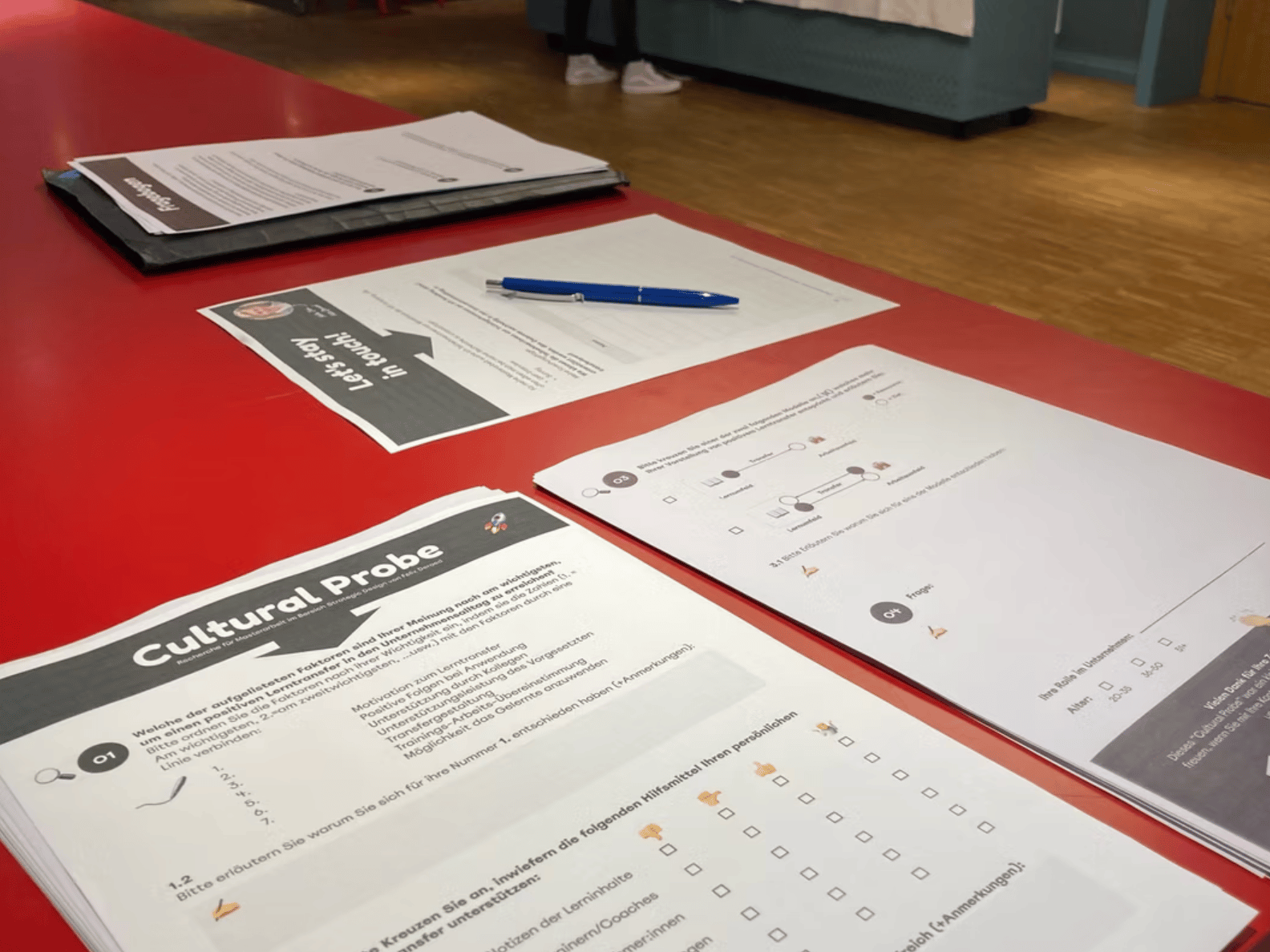
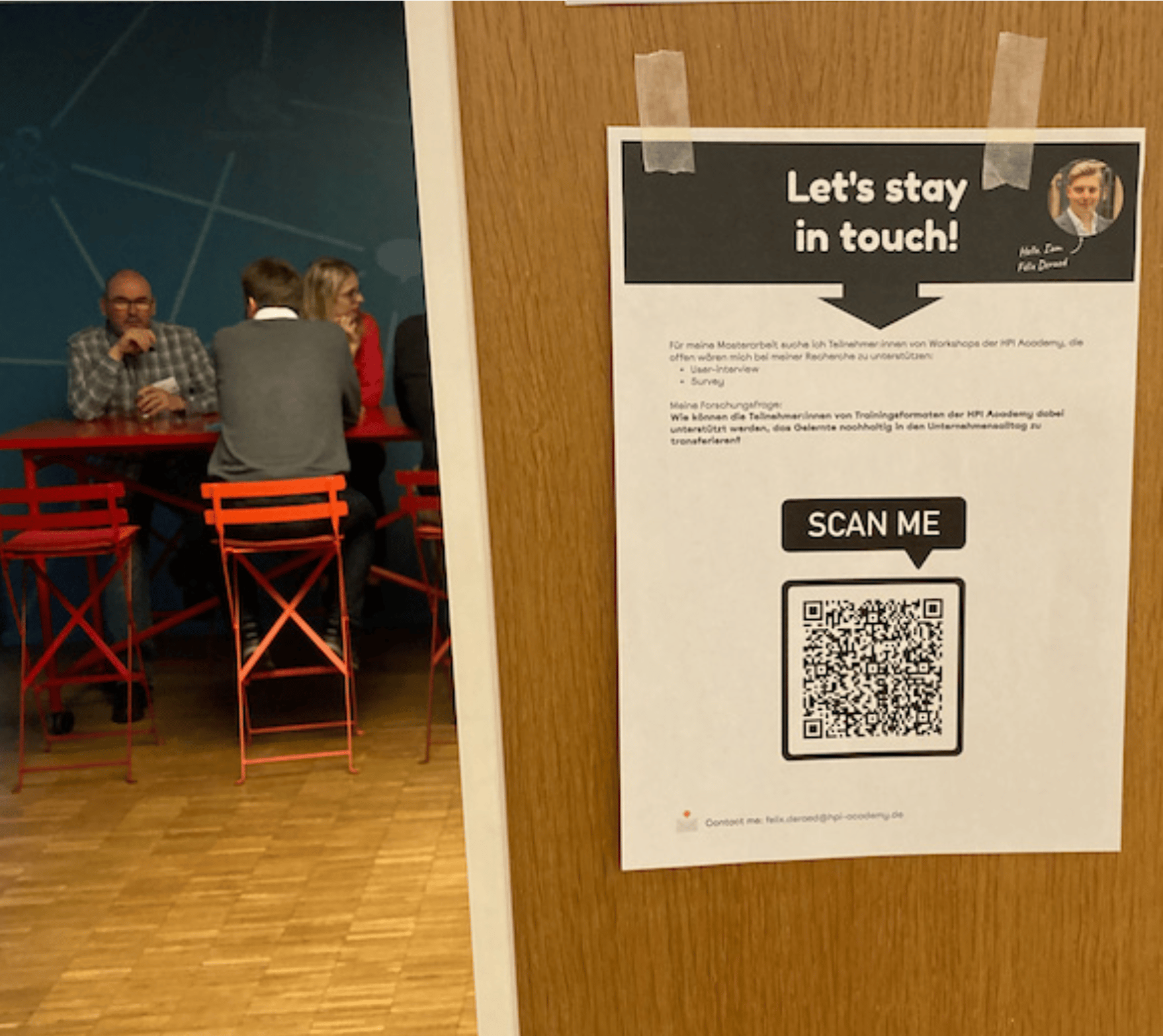
Fig. Cultural Probe and participants at HPI Academy
Impact
Understanding the full learning journey revealed that challenges are systemic—not limited to the training itself.
- Identified and recruited relevant participants for further testing
- Generated deep qualitative insights from 20+ interviews
- Uncovered patterns beyond the HPI context through external perspectives
- Built a holistic understanding across pre-, during, and post-training
- Deep Dive: Synthesizing Research into Insights
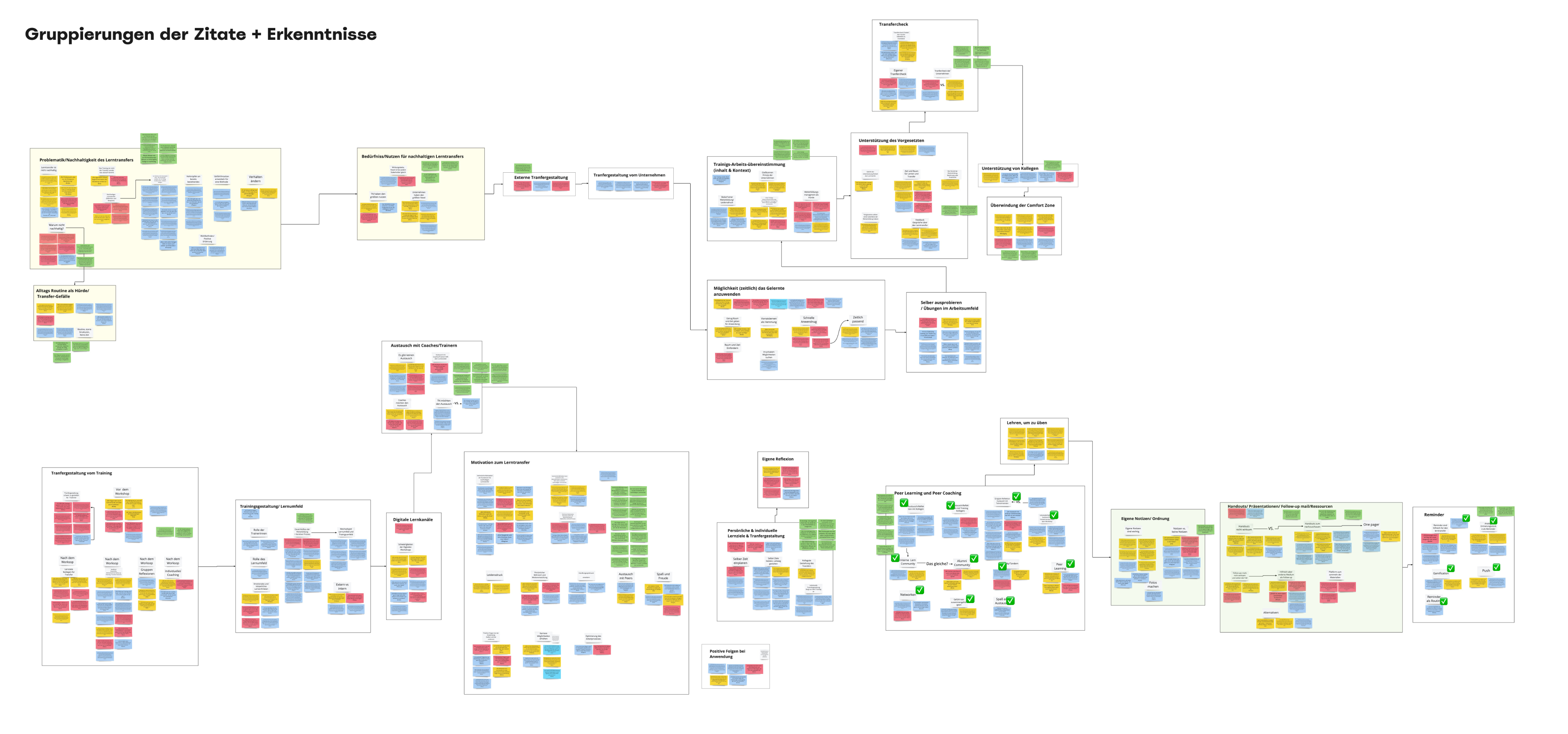
ApproachII used affinity mapping to synthesize 100+ quotes and observations from interviews and field research. This process revealed recurring patterns, which I structured into themes across the learning journey (before, during, and after training) and translated into initial hypotheses and insight statements.
Impact
This process uncovered that learning transfer results from a set of interconnected factors that influence one another.
- Transformed 100+ data points into clear, structured themes and their correlations
- Connected patterns across before, during, and after training
- Revealed systemic barriers across the learning journey
- Built the foundation for actionable insight statements
These patterns translated into the following key insights:
Key Insights
- Overemphasis on functional & educational brand communicationVolkswagen’s communication is primarily focused on functional and educational messaging, with limited emotional or immersive brand experiences.
Learning fades without integration into daily routinesNew methods are quickly overridden by time pressure and existing habits.
Confidence requires reinforcement, not just knowledgeWithout feedback and reassurance, applying new skills feels risky.
Transfer is the real challenge—not retentionUsers struggle to recognize when and how to apply knowledge in new situations.
Core inisght
Learning fails without progress visibilityWithout visibility into progress, challenges, and application, neither learners nor supporters can reinforce behavior change effectively.
Strategic Direction
Goal of the Phase
Transform research insights into actionable opportunity areas by identifying pain points, refining the problem, and defining user needs, creating a foundation for ideation and design.
Methods used
→ Stakeholder Mapping - Understanding relationships, roles, and influence between stakeholders.
→ Personas & POV - Clarifying user needs, motivations, and perspectives.
→ Creating HMWs and H2 questions - Reframing insights into actionable problem statements and guiding focused ideation
→ System Mapping - Revealing connections, dependencies, and systemic pain points.
→ Opportunity Fields - Identifying high-impact areas for design intervention.
Selected Deep Dives
Deep Dive: From System Mapping to Strategic Opportunities
Approach
I synthesized research insights into a system map to understand how different factors influence learning transfer. By translating insights into system elements, mapping dependencies, and identifying reinforcing and inhibiting feedback loops, key relationships and leverage points, ripple effects and opportunities for change across the learning journey became visible.
These leverage points represent areas where small interventions can create disproportionate positive impact on the overall system.
Fig. System Map

Impact
System mapping uncovered how interconnected variables shape learning transfer, enabling the identification of leverage points to drive meaningful systemic change.
- Identified reinforcing and inhibiting feedback loops across the learning journey
- Shifted the focus from individual behavior to organizational and contextual factors
- Provided a shared model to align stakeholders on the problem space
Enabled the translation of insights into strategic opportunity areas...
Strategic Opportunities
- Strengthen organizational support for learning transferHelp companies actively guide and reinforce employees’ application of new skills.
- Promote personal ownership of learning outcomesTrainees want to change old habits, but without feedback or reassurance, applying new skills feels risky—leading them to fall back on familiar routines as confidence fades.
- Increase motivation and visibility of learning transferProvide tools that keep learners engaged, track progress, and make transfer efforts transparent for both employees and supporters.
- Position effective transfer as a competitive advantageOffer solutions that bridge learning and practice, enabling organizations and training providers like HPI Academy to stand out in the market.
Concept Development & Validation
Goal of the Phase
Explore and develop solution directions based on research insights, and converge on the most promising concept through structured evaluation. Transform research insights into actionable opportunity areas by identifying pain points, refining the problem, and defining user needs—creating a foundation for the final service and product design.
Methods used
→ Multiple Ideation Workshops - Expanding the solution space from quantity to quality
→ Concept Development - Translating ideas into structured, tangible concepts
→ Concept Evaluation & Prioritization - Identifying the most relevant and promising direction
→ Service Blueprint – Visualizing the end-to-end service experience across touchpoints and stakeholders
→ Paper Prototyping – Quickly testing ideas and user flows at low cost
→ Low / High Fidelity Prototyping – Iteratively refining interaction and usability
→ User Testing of Iterations – Validating and improving concepts based on user feedback
Selected Deep Dive
- Deep Dive: From Ideas to Concept Directions
Approach
I facilitated ideation workshops with users and HPI coaches to explore open opportunity spaces with no established solutions. Building on personas and “How Might We” questions, I guided divergent thinking through collaborative ideation methods, synthesized outcomes into nine concept directions, and facilitated prioritization to identify the most promising path forward.
Impact
The structured ideation and evaluation process transformed a broad set of ideas into focused, validated concept directions with clear potential for impact.
- Expanded the solution space beyond obvious ideas
- Integrated diverse perspectives from coaches and users early on
- Translated ideas into tangible concepts
- Enabled structured, criteria-based decision-making
- Deep Dive: From Service Blueprint to Tested Solution
Approach
I translated the most promising concept into a service blueprint to map the end-to-end experience across stakeholders and touchpoints. In parallel, I developed and iteratively refined application prototypes — from low-fidelity paper flows to higher-fidelity interactions — to validate usability, user flows, and the overall experience.
Key Insights
- Overemphasis on functional & educational brand communicationVolkswagen’s communication is primarily focused on functional and educational messaging, with limited emotional or immersive brand experiences.
Engagement depends on continuous access and interactionUsers value the ability to track progress, access services, and connect with others in one place.
Core inisght
Learning needs a central, always-accessible touchpointUsers rely on a single, accessible entry point to engage with the ecosystem—enabling progress visibility, ongoing interaction, and connection to support.
The Solution
Enabling Sustainable Learning Transfer through Service Design
The service is designed as an end-to-end learning journey, guiding participants from selecting the right training to continuously applying and reflecting on new skills in their daily work:
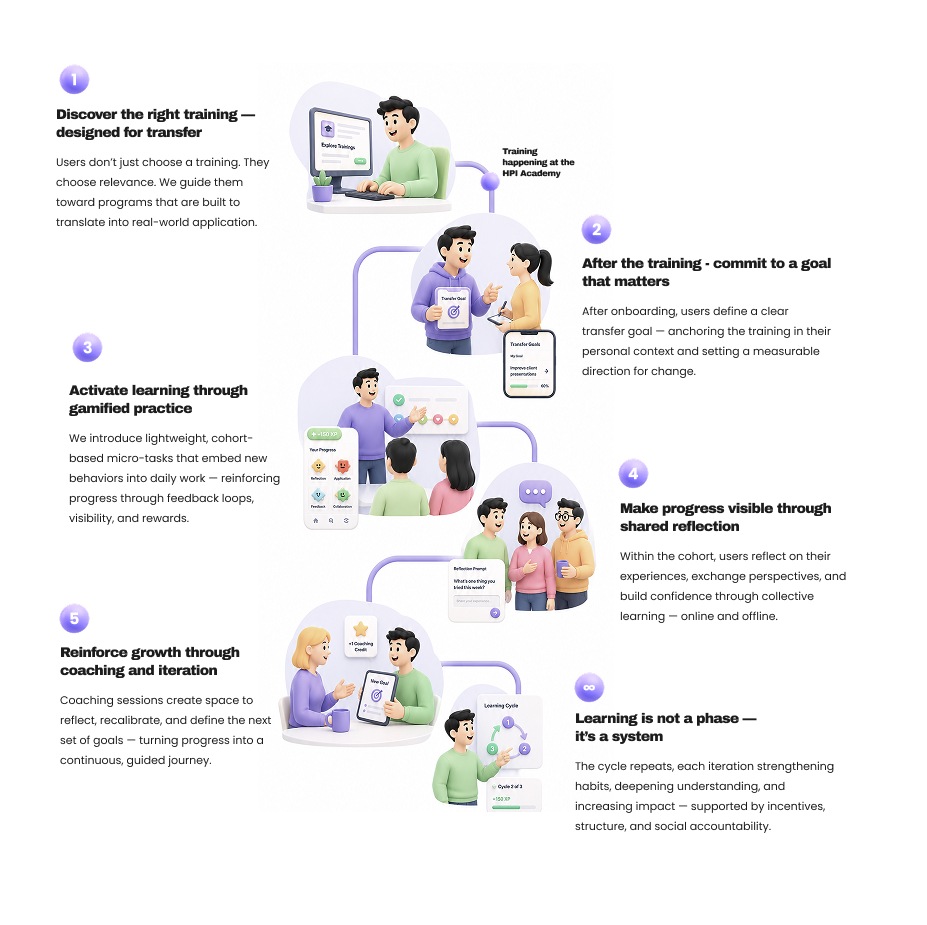
+ The App: An All-in-One Platform for Learning Transfer
A platform designed to extend learning beyond training by embedding it into everyday work. Through personalized tasks, gamification, and structured reflection, it supports users in understanding, applying, and sustaining new skills over time.
Implementation Planning
Goal of the Phase
Translate the solution into a scalable and feasible service model by aligning user needs, business goals, and operational requirements.
Methods used
→ Vision & Mission Statements– Visualizing the end-to-end service experience across touchpoints and stakeholders
→ Branding & Design System – Quickly testing ideas and user flows at low cost
→ Road Map – Iteratively refining interaction and usability
→ Business Model Canvas – Validating and improving concepts based on user feedback
Selected Outcomes
- Business Model Canvas
Defined how the solution creates, delivers, and captures value across stakeholders—ensuring alignment with business goals and long-term viability.
- Value Proposition Map
Mapped user needs, pains, and gains to define a clear and relevant value proposition—ensuring the solution addresses real user problems.
- Roadmap
Defined a phased roadmap from pilot to scalable product—ensuring a clear path to implementation and growth.
Impact
Turned the concept into a structured, stakeholder-aligned plan—enabling HPI Academy to evaluate feasibility, align internally, and move toward implementation.
- Ensures the solution is viable and aligned with business and organizational goals
- Ensures the solution addresses real user needs and delivers meaningful value
- Provides a clear path to implementation, enabling structured execution and scalable growth
Final Impact
Turned the concept into a structured, stakeholder-aligned plan—enabling HPI Academy to evaluate feasibility, align internally, and move toward implementation.
Reflection
Learned to design for systems and behavior change, not just individual touchpoints.
Next
Pilot the solution and validate long-term impact in real-world use.
Félix Deraed
Strategic Designer

Berlin, Germany

Case Study
Creating Lasting
Learning Habits
Designing a service ecosystem that enables HPI Academy trainees to translate learning goals
into lasting habits through gamified practice, peer reflection, and mentor guidance.
Context

Hasso-Plattner-Insitute Academy (d-school) is one of Europe’s leading institutions for Design Thinking education and corporate innovation programs. A recurring challenge is that participants often struggle to apply newly learned methods sustainably in their daily work. I collaborated with the Corporate Innovation and Leadership team at HPI Academy to deeply understand this problem and design human-centered solutions that support lasting learning and practical application.
Project Partner
HPI Academy
Duration
+6 months
Topics
Strategic, Service & UX Design
Role
Strategic Designer
My Role & Process
My role as a Strategic Designer was to explore the problem and solution spaces holistically, connecting user needs, business requirements, and system
perspectives:
- Led in-depth research to uncover actionable user insights (20+ Interviews)
- Translated insights into clear opportunity areas and strategic directions
- Drove iterative ideation and prototyping to validate and converge on the best solution (3+ Workshops)
- Defined implementation strategy (branding, service blueprint, roadmap, business model) for scalability and fit
- Delivered a validated concept and strategic framework to HPI Academy for implementation


Desk &
User Research
Problem Phase
Challenge
Outcome
Solution Phase
Implementation
Strategic Direction
Concept Development
Prototyping & Testing
Strategy & Roadmap
Deliver &
Validation


Focus and Intensity of Work

Problem Statement
- The Gap Between Learning and Doing
Coaches often have limited influence on this process, leaving participants without adequate support for the learning transfer after trainings. Resulting in a lower overall impact of training programs.
- Missed ROI: Training Without Application
Organizations invest heavily in training methods like Design Thinking, but the newly learned skills rarely become part of routine workflows.
Challenge
Empowering participants to confidently apply new skills in their daily work.
Core tension:
- Bridging the gap between learning and doing
- Fostering measurable progress, and equipping coaches and peers to support lasting behavioral change.
Research & Insights
Goal of the Research Phase
Build a deep understanding of participants’ and coaches’ experiences to uncover systemic barriers and opportunities for effective learning transfer.
Methods used
→ Desk & Literature Research – established theoretical foundation
→ User & Expert Interviews – gathered perspectives and pain points
→ Guerrilla Research & Cultural Probes – explored trainee experiences
→ Affinity Mapping – identified patterns and insights
→ Insights Synthesis – informed human-centered design decisions
Selected Deep Dives
- Deep Dive: From Field Research to User Insights
ApproachI combined in-context interviews with structured qualitative research to capture perspectives across the full learning journey. This included short interviews during and after workshops, cultural probes for out-of-context reflections, and 20 in-depth interviews with coaches, experts, and participants across both internal and external programs.
“We often don’t get supported after training, simply because neither our colleagues nor our manager have visibility into what we’re supposed to transfer into our daily work.” - Training Participant
“The contact with others help, because you can exchange experiences: How did you apply it?” - HPI Coach
Fig. Cultural Probe and participants at HPI Academy
Impact
Understanding the full learning journey revealed that challenges are systemic—not limited to the training itself.
- Identified and recruited relevant participants for further testing
- Generated deep qualitative insights from 20+ interviews
- Uncovered patterns beyond the HPI context through external perspectives
- Built a holistic understanding across pre-, during, and post-training
- Deep Dive: Synthesizing Research into Insights
ApproachII used affinity mapping to synthesize 100+ quotes and observations from interviews and field research. This process revealed recurring patterns, which I structured into themes across the learning journey (before, during, and after training) and translated into initial hypotheses and insight statements.
Fig. Affinity Map und Verbindungen der Themenfelder
External Coaches
HPI Coaches
Participants
Inisghts


Impact
This process uncovered that learning transfer results from a set of interconnected factors that influence one another.
- Transformed 100+ data points into clear, structured themes and their correlations
- Connected patterns across before, during, and after training
- Revealed systemic barriers across the learning journey
- Built the foundation for actionable insight statements
These patterns translated into the following key insights:
Key Insights
- Overemphasis on functional & educational brand communicationVolkswagen’s communication is primarily focused on functional and educational messaging, with limited emotional or immersive brand experiences.
Learning fades without integration into daily routinesNew methods are quickly overridden by time pressure and existing habits.
Confidence requires reinforcement, not just knowledgeWithout feedback and reassurance, applying new skills feels risky.
Transfer is the real challenge—not retentionUsers struggle to recognize when and how to apply knowledge in new situations.
Core inisght
Learning fails without progress visibilityWithout visibility into progress, challenges, and application, neither learners nor supporters can reinforce behavior change effectively.
Strategic Direction
Goal of the Phase
Transform research insights into actionable opportunity areas by identifying pain points, refining the problem, and defining user needs, creating a foundation for ideation and design.
Methods used
→ Stakeholder Mapping - Understanding relationships, roles, and influence between stakeholders.
→ Personas & POV - Clarifying user needs, motivations, and perspectives.
→ Creating HMWs and H2 questions - Reframing insights into actionable problem statements and guiding focused ideation
→ System Mapping - Revealing connections, dependencies, and systemic pain points.
→ Opportunity Fields - Identifying high-impact areas for design intervention.
Selected Deep Dives
Deep Dive: From System Mapping to Strategic Opportunities
Approach
I synthesized research insights into a system map to understand how different factors influence learning transfer. By translating insights into system elements, mapping dependencies, and identifying reinforcing and inhibiting feedback loops, key relationships and leverage points, ripple effects and opportunities for change across the learning journey became visible.
These leverage points represent areas where small interventions can create disproportionate positive impact on the overall system.
Fig. System Map
Impact
System mapping uncovered how interconnected variables shape learning transfer, enabling the identification of leverage points to drive meaningful systemic change.
- Identified reinforcing and inhibiting feedback loops across the learning journey
- Shifted the focus from individual behavior to organizational and contextual factors
- Provided a shared model to align stakeholders on the problem space
Enabled the translation of insights into strategic opportunity areas...
Strategic Opportunities
- Strengthen organizational support for learning transferHelp companies actively guide and reinforce employees’ application of new skills.
- Promote personal ownership of learning outcomesTrainees want to change old habits, but without feedback or reassurance, applying new skills feels risky—leading them to fall back on familiar routines as confidence fades.
- Increase motivation and visibility of learning transferProvide tools that keep learners engaged, track progress, and make transfer efforts transparent for both employees and supporters.
- Position effective transfer as a competitive advantageOffer solutions that bridge learning and practice, enabling organizations and training providers like HPI Academy to stand out in the market.
Concept Development & Validation
Goal of the Phase
Explore and develop solution directions based on research insights, and converge on the most promising concept through structured evaluation. Transform research insights into actionable opportunity areas by identifying pain points, refining the problem, and defining user needs—creating a foundation for the final service and product design.
Methods used
→ Multiple Ideation Workshops - Expanding the solution space from quantity to quality
→ Concept Development - Translating ideas into structured, tangible concepts
→ Concept Evaluation & Prioritization - Identifying the most relevant and promising direction
→ Service Blueprint – Visualizing the end-to-end service experience across touchpoints and stakeholders
→ Paper Prototyping – Quickly testing ideas and user flows at low cost
→ Low / High Fidelity Prototyping – Iteratively refining interaction and usability
→ User Testing of Iterations – Validating and improving concepts based on user feedback
Selected Deep Dive
- Deep Dive: From Ideas to Concept Directions
Approach
I facilitated ideation workshops with users and HPI coaches to explore open opportunity spaces with no established solutions. Building on personas and “How Might We” questions, I guided divergent thinking through collaborative ideation methods, synthesized outcomes into nine concept directions, and facilitated prioritization to identify the most promising path forward.
Fig. left: online ideation session with HPI coaches; Fig. right: Ideation workshops with external users
Impact
The structured ideation and evaluation process transformed a broad set of ideas into focused, validated concept directions with clear potential for impact.
- Expanded the solution space beyond obvious ideas
- Integrated diverse perspectives from coaches and users early on
- Translated ideas into tangible concepts
- Enabled structured, criteria-based decision-making
- Deep Dive: From Service Blueprint to Tested Solution
Approach
I translated the most promising concept into a service blueprint to map the end-to-end experience across stakeholders and touchpoints. In parallel, I developed and iteratively refined application prototypes — from low-fidelity paper flows to higher-fidelity interactions — to validate usability, user flows, and the overall experience.
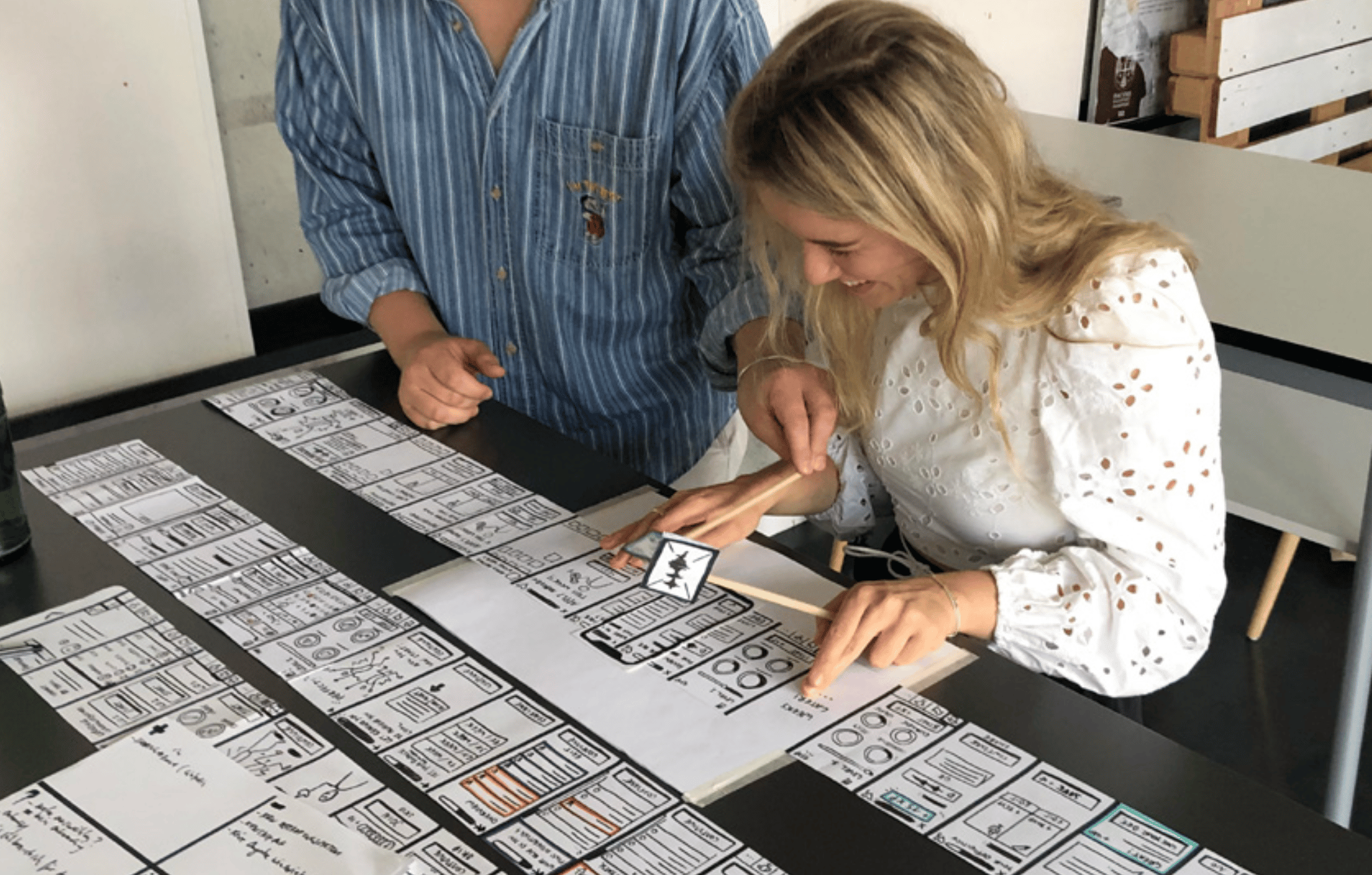
Fig. left: Service Blueprint; right: Testing service concept & paper prototype
Impact
By combining service blueprinting with iterative prototyping, the solution was tested both on interaction and system level—ensuring it works across touchpoints and stakeholders.
- Made abstract concepts tangible and testable
- Validated key assumptions with real users and ensured the solution works across the full service ecosystem
- Identified usability issues early and iteratively improved the design
- Increased confidence in the final design direction
During concept development and validation, two key insights emerged...
Key Insights
- Overemphasis on functional & educational brand communicationVolkswagen’s communication is primarily focused on functional and educational messaging, with limited emotional or immersive brand experiences.
Engagement depends on continuous access and interactionUsers value the ability to track progress, access services, and connect with others in one place.
Core inisght
Learning needs a central, always-accessible touchpointUsers rely on a single, accessible entry point to engage with the ecosystem—enabling progress visibility, ongoing interaction, and connection to support.
The Solution
Enabling Sustainable Learning Transfer through Service Design
The service is designed as an end-to-end learning journey, guiding participants from selecting the right training to continuously applying and reflecting on new skills in their daily work:

Discover the right training — designed for transfer
Users don’t just choose a training. They choose relevance. We guide them toward programs that are built to translate into real-world application.
1
After the training - commit to a goal that matters
After onboarding, users define a clear transfer goal — anchoring the training in their personal context and setting a measurable direction for change.
2
Activate learning through gamified practice
We introduce lightweight, cohort-based micro-tasks that embed new behaviors into daily work — reinforcing progress through feedback loops, visibility, and rewards.
3
Make progress visible through shared reflection
Within the cohort, users reflect on their experiences, exchange perspectives, and build confidence through collective learning — online and offline.
4
Reinforce growth through coaching and iteration
Coaching sessions create space to reflect, recalibrate, and define the next set of goals — turning progress into a continuous, guided journey.
5
Learning is not a phase — it’s a system
The cycle repeats, each iteration strengthening habits, deepening understanding, and increasing impact — supported by incentives, structure, and social accountability.
∞
+ The App: An All-in-One Platform for Learning Transfer
A platform designed to extend learning beyond training by embedding it into everyday work. Through personalized tasks, gamification, and structured reflection, it supports users in understanding, applying, and sustaining new skills over time.
Implementation Planning
Goal of the Phase
Translate the solution into a scalable and feasible service model by aligning user needs, business goals, and operational requirements.
Methods used
→ Vision & Mission Statements– Visualizing the end-to-end service experience across touchpoints and stakeholders
→ Branding & Design System – Quickly testing ideas and user flows at low cost
→ Road Map – Iteratively refining interaction and usability
→ Business Model Canvas – Validating and improving concepts based on user feedback
Selected Outcomes
- Business Model Canvas
Defined how the solution creates, delivers, and captures value across stakeholders—ensuring alignment with business goals and long-term viability.
- Value Proposition Map
Mapped user needs, pains, and gains to define a clear and relevant value proposition—ensuring the solution addresses real user problems.


Product & Services
Creating Value
Pain Relievers
Pains
Costumer Jobs
Gains


Product & Service
- Step‑by‑step guidance for formulating and achieving transfer goals
- Smartphone app with playful and Individualized transfer tasks for practicing and reflecting on newly learned skills
- Feedback sessions with trainers
Creating Value
- Helps users gain a better overview of their personal transfer progress and long‑term learning experience
- Provides step‑by‑step guidance for achieving transfer goals
- Enables practice and reflection on newly acquired skills ans allows receiving individualized feedback from others.
Pain Relievers
- Reduces the risk that newly learned content is not applied
- Provides clear visibility of transfer progress and wenables easy sharing of transfer progress with others
- Guarantees consistent transfer success
Pains
- Daily routines prevent newly learned skills from being applied
- Exposure to many new methods without mastering any of them
- Supervisors being dissatisfied when new learnings are not applied successfully
- Lack of time and perseverance to apply new learnings consistently
Costumer Jobs
- Personal development and Improved team performance
- Integrating innovative approaches into company culture
Gains
- Ability to integrate multiple methods from training into daily work
- Transparent overview of transfer progress and individual support following a training session
- More feedback regarding progress in applying new learnings
- Recognition for successfully implementing new skills
- Roadmap
Defined a phased roadmap from pilot to scalable product—ensuring a clear path to implementation and growth.


Milestone: Beta Launch
Introduce Bemind Service for the Basic Design Thinking training at HPI.
Milestone: Official Launch
Roll out learning transfer support to four additional training programs.
Milestone: Final Rollout
Implement learning transfer support across all training programs.
Optional Milestone: Scaling
Enable external training providers to offer their own learning transfer support for their training programs through the Bemind app.
in 6-10
months
in 24-36
months
in 48-72
months
after 72
months
Usage of the app and number of transfer tasks increase over time
Impact
Turned the concept into a structured, stakeholder-aligned plan—enabling HPI Academy to evaluate feasibility, align internally, and move toward implementation.
- Ensures the solution is viable and aligned with business and organizational goals
- Ensures the solution addresses real user needs and delivers meaningful value
- Provides a clear path to implementation, enabling structured execution and scalable growth
Final Impact
Turned the concept into a structured, stakeholder-aligned plan—enabling HPI Academy to evaluate feasibility, align internally, and move toward implementation.
Reflection
Learned to design for systems and behavior change, not just individual touchpoints.
Next
Pilot the solution and validate long-term impact in real-world use.
Félix Deraed
Strategic Designer
Berlin, Germany
Currently
Strategic & Experience Designer
at Volkswagen Group Services GmbH
