Case Study
Enabling Remote
Vision Care
Exploring and validating the integration of virtual vision testing and try-on guidance into the eyewear shopping experience with a focus on building trust and driving user adoption in emerging markets.
Confidentiality Disclaimer
This project was developed in collaboration with ZEISS. The product and underlying business concept are currently still in development. Certain details have been simplified or anonymized due to confidentiality.

Context
As part of its digital transformation, ZEISS is exploring new ways to expand access to vision care beyond traditional retail channels. In many rural areas of non-EU markets, access to optical services and eyewear retailers is limited, making physical store visits time-consuming and difficult. This project explores how digital solutions can enable remote vision testing and product discovery — creating a seamless and scalable entry point into the ZEISS ecosystem.
Project Partner
ZEISS
Duration
4 months
Topics
Product Strategy, Prototyping, User Testing
Role
UX Strategist & Researcher
My Role & Process
I worked as a Freelance UX Strategist & Researcher leading the project independently in close collaboration with two Product Owners. My role spanned from research and product strategy to concept development, prototyping, testing, and stakeholder alignment.
- Led research and synthesis to uncover key user and market insights
- Defined the product vision and strategic direction
- Designed and validated concepts through rapid prototyping and iterative testing (30+ User Tests)
- Facilitated stakeholder alignment across teams and decision-makers (+8 Stakeholder)
Problem Statement
- Lack of user behavior insights in the target market
There is limited understanding of how users in the target market interact with digital health solutions, including their expectations, trust levels, and behavioral patterns.
- Uncertainty around feasibility and acceptance
It is unclear whether remote vision testing and virtual try-on are technically viable and culturally accepted.
Challenge
Build trust in remote vision testing so users feel confident buying glasses from home.
Core tension:
- Designing for a different cultural and digital context
- Building trust in a remote, self-guided health-related process
- Integrating vision testing and virtual try-on into a familiar buying journey
Setting up the Research Framework
Goal of the Phase
This phase established the foundation for validation by aligning technical constraints, user needs, and early concept assumptions ensuring that all prototypes were grounded in real-world context.
Methods used
→ Technology Deep Dive – understand the capabilities and limitations of the vision testing and virtual try-on technology
→ Desk Research – Explored market conditions, access barriers, and cultural context in emerging markets
→ Initial User Research – 5 exploratory interviews with users in the target market to understand behavior and trust
→ Persona Development – Created simplified personas to guide design decisions based on Interview insights
→ User Flow Definition – Translated insights into initial end-to-end user journeys
→ Rapid Prototyping – Built low-fidelity prototypes to quickly test core assumptions and interaction principles
My Approach
High uncertainty required a fast, learning-driven approach:
- Rapid prototyping to make ideas tangible early and test assumptions in real user contexts
- Continuous learning from iterative refinement based on user feedback
Selected Deep Dive
- Deep Dive: Mapping the End-to-End Experience
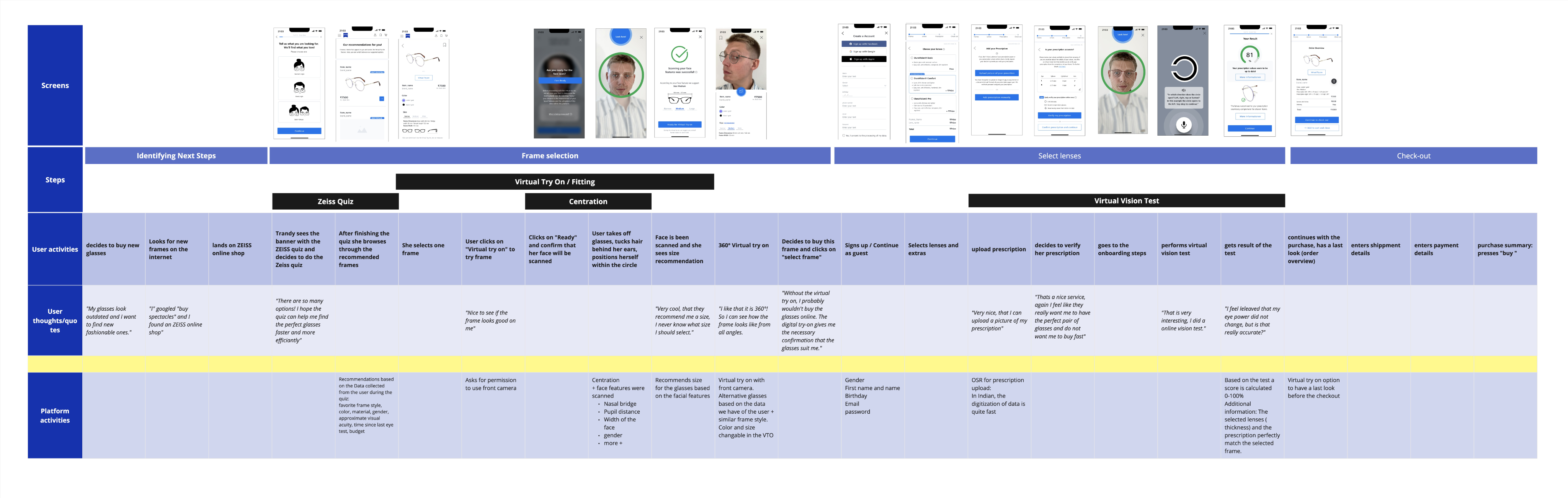
ApproachTo understand how the measurement feature fits into the overall experience, I created an end-to-end user journey that integrates key product flows, including virtual try-on and vision testing. The journey combines prototype screens with user actions, thoughts, and system responses.
Impact
Served as the foundation to identify critical assumptions and translate them into testable hypotheses for the first iteration:
- Enabled a hypothesis-driven testing approach grounded in real user flows
- Aligned stakeholders around a shared understanding of the experience
- Established a clear foundation for iterative validation and learning cycles
Iterative Validation & Learning Loops
Goal of the Phase
Test core assumptions around trust, usability, and feature integration in a high-uncertainty context.
Approach
Hypothesis-driven testing with rapid iterations based on real user feedback:
→ 3 Testings & Iterations - hypothesis → prototype → test → insight → iteration
→ 20 Users - target group from emerging market
→ 45min sessions – moderated remote usability testing
Testing & Iteration 01
Validate overall process and user trust, 6 users
Testing & Iteration 02
Evaluate measurement features and integration, 9 users
Testing & Iteration 03
Optimize decision-making and purchase confidence, 5 users

Deep Dive: First Iteration (User Testing)

- Defining Hypotheses & Prototyoe flows
Key assumptions were translated into testable hypotheses across four areas: trust, virtual try-on, vision testing, and data collection. Each hypothesis was operationalized through targeted user questions and dedicated prototype flows to systematically validate behavior, perception, and decision-making.
- Testing Setup
6 participants from rural target markets were recruited (vision correction users, online shoppers, basic English). I conducted moderated usability testing via video calls using a Figma prototype and think-aloud method.
- Synthesize & Iterate
Each hypothesis was evaluated as approved, partially approved, or not approved, supported by detailed insights.Usability issues, improvement opportunities, and positive interactions were mapped to specific prototype screens, directly informing design decisions.
Key Insights
Interest does not equal confidenceThe feature attracts attention but does not remove hesitation in decision-making.
Trust depends on clear information and guidanceTrust depends on clear information and guidance
→ Iteartion direction: Increase transparency and validation cues to build trust in result accuracy.
Core inisght
High interest in virtual testing — but trust remains the key barrier to adoptionUsers are excited about the feature but hesitate due to uncertainty about result accuracy.
User Evidence

“I really like that you can verify the prescription, it is something I haven't seen before.”
- Participant
“I’m not sure how accurate the results are… I would probably want to double-check before trusting it.” - Participant
Impact
- Revealed hidden barriers beyond usability, especially around trust, understanding, and decision confidence
- Showed that intuitive flows alone are not enough — users need clarity and reassurance to proceed
- Enabled testing of assumptions in real context, uncovering issues that wouldn’t surface in concept discussions
- Directly informed iteration by shifting focus from interface design to trust-building mechanisms
Final Impact
The findings led to a green light to integrate the vision testing and measurement capability into the core shopping experience — shifting it from an experimental feature to a key driver of trust and conversion.
Reflection
The core challenge was not designing the solution — but navigating uncertainty and aligning stakeholders around the right problem.
Case Study
Enabling Remote
Vision Care
Exploring and validating the integration of virtual vision testing and try-on guidance into the eyewear shopping experience with a focus on building trust and driving user adoption in emerging markets.
Confidentiality Disclaimer
This project was developed in collaboration with ZEISS. The product and underlying business concept are currently still in development. Certain details have been simplified or anonymized due to confidentiality.
Context
As part of its digital transformation, ZEISS is exploring new ways to expand access to vision care beyond traditional retail channels. In many rural areas of non-EU markets, access to optical services and eyewear retailers is limited, making physical store visits time-consuming and difficult. This project explores how digital solutions can enable remote vision testing and product discovery — creating a seamless and scalable entry point into the ZEISS ecosystem.
Project Partner
ZEISS
Duration
4 months
Topics
Product Strategy, Prototyping, User Testing
Role
UX Strategist & Researcher
My Role & Process
I worked as a Freelance UX Strategist & Researcher leading the project independently in close collaboration with two Product Owners. My role spanned from research and product strategy to concept development, prototyping, testing, and stakeholder alignment.
- Led research and synthesis to uncover key user and market insights
- Defined the product vision and strategic direction
- Designed and validated concepts through rapid prototyping and iterative testing (30+ User Tests)
- Facilitated stakeholder alignment across teams and decision-makers (+8 Stakeholder)
Problem Statement
- Lack of user behavior insights in the target market
There is limited understanding of how users in the target market interact with digital health solutions, including their expectations, trust levels, and behavioral patterns.
- Uncertainty around feasibility and acceptance
It is unclear whether remote vision testing and virtual try-on are technically viable and culturally accepted.
Challenge
Build trust in remote vision testing so users feel confident buying glasses from home.
Core tension:
- Designing for a different cultural and digital context
- Building trust in a remote, self-guided health-related process
- Integrating vision testing and virtual try-on into a familiar buying journey
Setting up the Research Framework
Goal of the Phase
This phase established the foundation for validation by aligning technical constraints, user needs, and early concept assumptions ensuring that all prototypes were grounded in real-world context.
Methods used
→ Technology Deep Dive – understand the capabilities and limitations of the vision testing and virtual try-on technology
→ Desk Research – Explored market conditions, access barriers, and cultural context in emerging markets
→ Initial User Research – 5 exploratory interviews with users in the target market to understand behavior and trust
→ Persona Development – Created simplified personas to guide design decisions based on Interview insights
→ User Flow Definition – Translated insights into initial end-to-end user journeys
→ Rapid Prototyping – Built low-fidelity prototypes to quickly test core assumptions and interaction principles
My Approach
High uncertainty required a fast, learning-driven approach:
- Rapid prototyping to make ideas tangible early and test assumptions in real user contexts
- Continuous learning from iterative refinement based on user feedback
Selected Deep Dive
- Deep Dive: Mapping the End-to-End Experience
ApproachTo understand how the measurement feature fits into the overall experience, I created an end-to-end user journey that integrates key product flows, including virtual try-on and vision testing. The journey combines prototype screens with user actions, thoughts, and system responses.
Impact
Served as the foundation to identify critical assumptions and translate them into testable hypotheses for the first iteration:
- Enabled a hypothesis-driven testing approach grounded in real user flows
- Aligned stakeholders around a shared understanding of the experience
- Established a clear foundation for iterative validation and learning cycles
Iterative Validation & Learning Loops
Goal of the Phase
Test core assumptions around trust, usability, and feature integration in a high-uncertainty context.
Approach
Hypothesis-driven testing with rapid iterations based on real user feedback:
→ 3 Testings & Iterations - hypothesis → prototype → test → insight → iteration
→ 20 Users - target group from emerging market
→ 45min sessions – moderated remote usability testing
Testing & Iteration 01
Validate overall process and user trust, 6 users
Testing & Iteration 02
Evaluate measurement features and integration, 9 users
Testing & Iteration 03
Optimize decision-making and purchase confidence, 5 users

Deep Dive: First Iteration (User Testing)
- Defining Hypotheses & Prototyoe flows
Key assumptions were translated into testable hypotheses across four areas: trust, virtual try-on, vision testing, and data collection. Each hypothesis was operationalized through targeted user questions and dedicated prototype flows to systematically validate behavior, perception, and decision-making.
- Testing Setup
6 participants from rural target markets were recruited (vision correction users, online shoppers, basic English). I conducted moderated usability testing via video calls using a Figma prototype and think-aloud method.
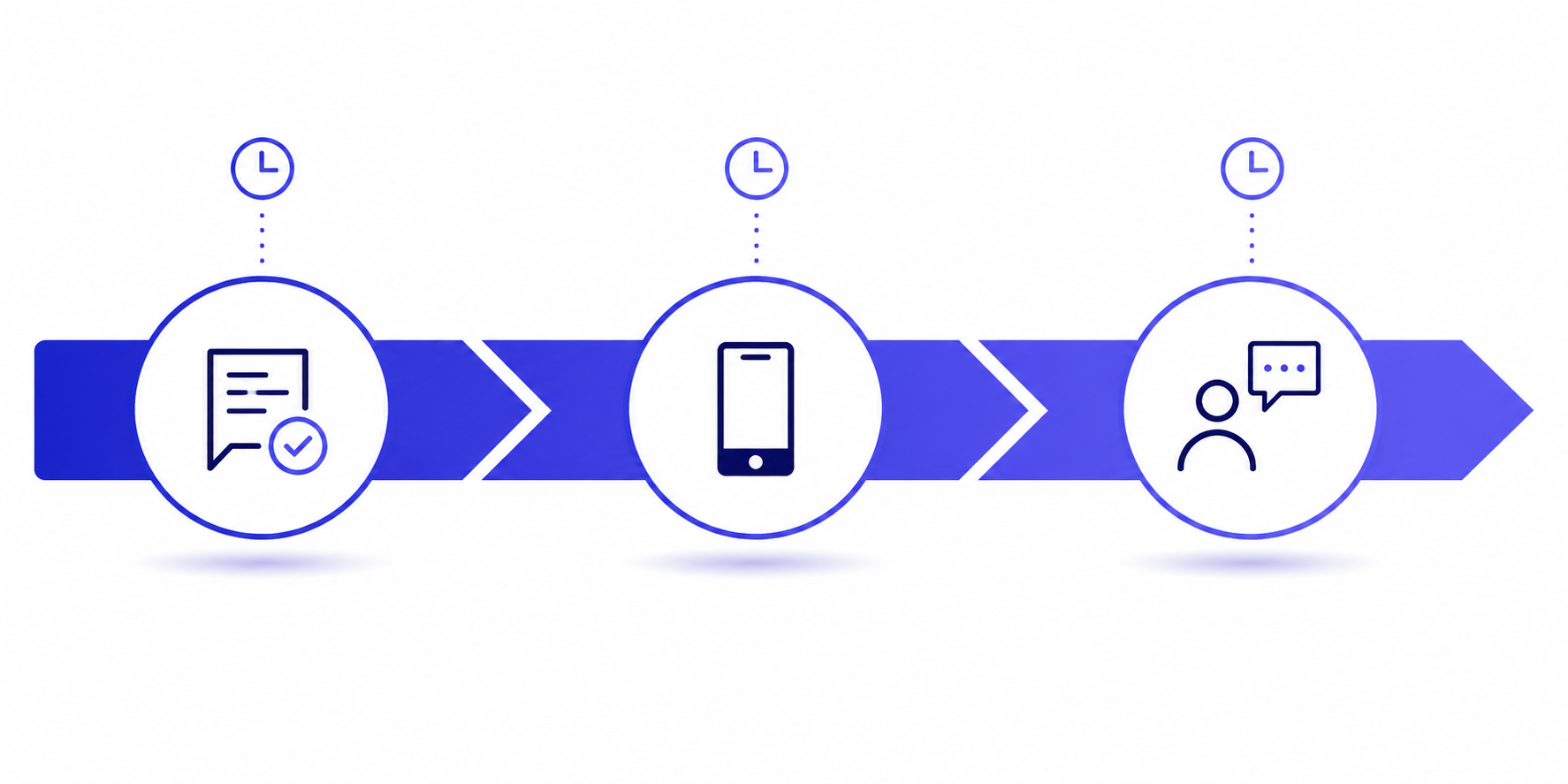
Introduction
(5–7 min)
Think-Aloud Testing
(15–20 min)
Qualitative Interview
(15–20 min)
- Synthesize & Iterate
Each hypothesis was evaluated as approved, partially approved, or not approved, supported by detailed insights.Usability issues, improvement opportunities, and positive interactions were mapped to specific prototype screens, directly informing design decisions.
Key Insights
- Overemphasis on functional & educational brand communicationVolkswagen’s communication is primarily focused on functional and educational messaging, with limited emotional or immersive brand experiences.
Interest does not equal confidenceThe feature attracts attention but does not remove hesitation in decision-making.
Trust depends on clear information and guidanceTrust depends on clear information and guidance
→ Iteartion direction: Increase transparency and validation cues to build trust in result accuracy.
Core inisght
High interest in virtual testing — but trust remains the key barrier to adoptionUsers are excited about the feature but hesitate due to uncertainty about result accuracy.
User Evidence
“I really like that you can verify the prescription, it is something I haven't seen before.”
- Participant
“I’m not sure how accurate the results are… I would probably want to double-check before trusting it.” - Participant
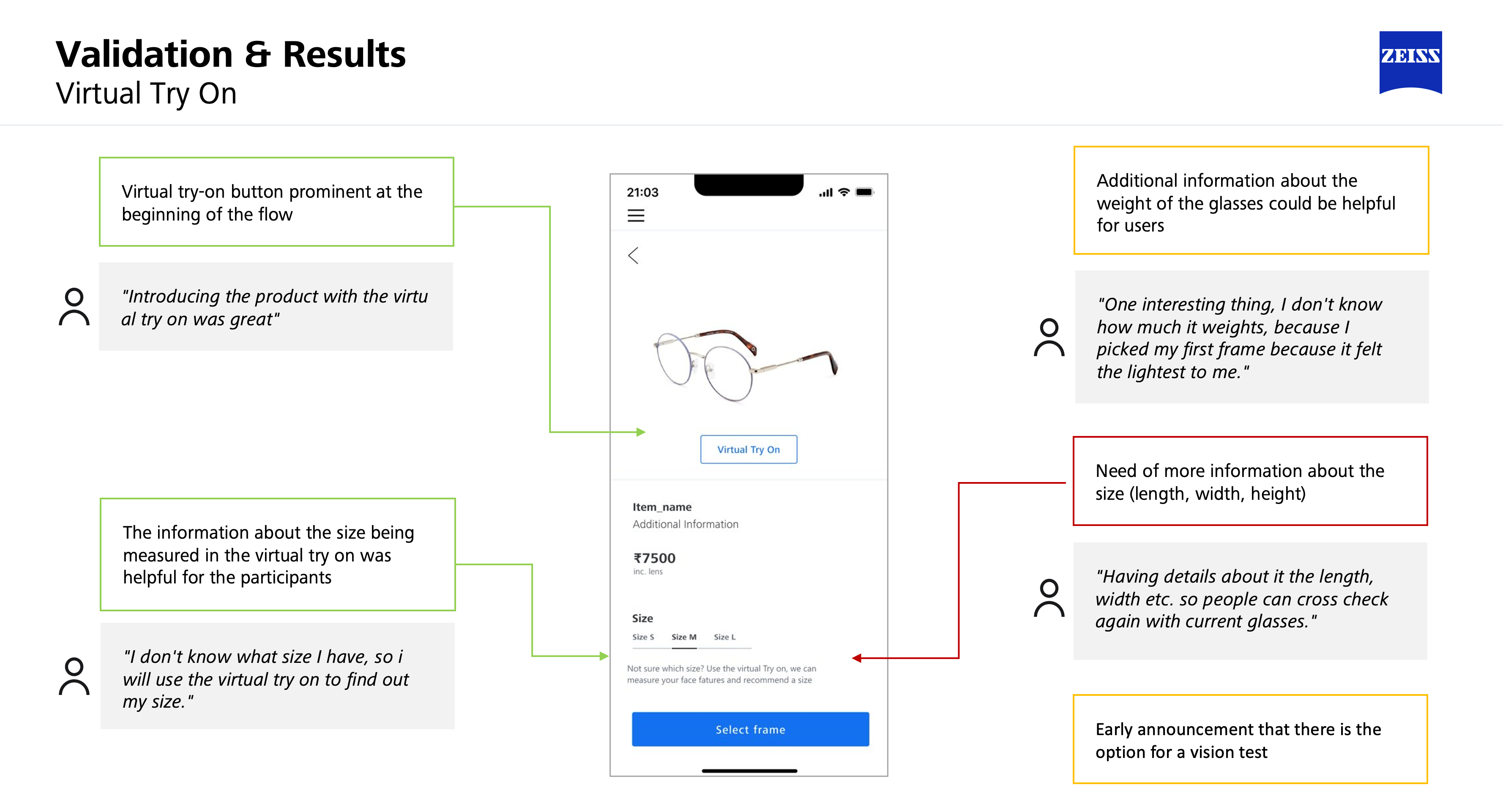
Fig.: Documentation of results for Virtual Try on Feature
Impact
- Revealed hidden barriers beyond usability, especially around trust, understanding, and decision confidence
- Showed that intuitive flows alone are not enough — users need clarity and reassurance to proceed
- Enabled testing of assumptions in real context, uncovering issues that wouldn’t surface in concept discussions
- Directly informed iteration by shifting focus from interface design to trust-building mechanisms
Final Impact
The findings led to a green light to integrate the vision testing and measurement capability into the core shopping experience — shifting it from an experimental feature to a key driver of trust and conversion.
Reflection
The core challenge was not designing the solution — but navigating uncertainty and aligning stakeholders around the right problem.
Félix Deraed
Strategic Designer

Berlin, Germany

Case Study
Enabling Remote
Vision Care
Exploring and validating the integration of virtual vision testing and try-on guidance into the eyewear shopping
experience with a focus on building trust and driving user adoption in emerging markets.
Confidentiality Disclaimer
This project was developed in collaboration with ZEISS. The product and underlying business concept are currently still in development. Certain details have been simplified or anonymized due to confidentiality.
Context
As part of its digital transformation, ZEISS is exploring new ways to expand access to vision care beyond traditional retail channels. In many rural areas of non-EU markets, access to optical services and eyewear retailers is limited, making physical store visits time-consuming and difficult. This project explores how digital solutions can enable remote vision testing and product discovery — creating a seamless and scalable entry point into the ZEISS ecosystem.
Project Partner
ZEISS
Duration
4 months
Topics
Product Strategy, Prototyping, User Testing
Role
UX Strategist & Researcher
My Role & Process
I worked as a Freelance UX Strategist & Researcher leading the project independently in close collaboration with two Product Owners. My role spanned from research and product strategy to concept development, prototyping, testing, and stakeholder alignment.
- Led research and synthesis to uncover key user and market insights
- Defined the product vision and strategic direction
- Designed and validated concepts through rapid prototyping and iterative testing (30+ User Tests)
- Facilitated stakeholder alignment across teams and decision-makers (+8 Stakeholder)


Desk &
User Research
Problem Phase
Challenge
Outcome
Solution Phase
Implementation
Strategic Direction
Concept Developement
Prototyping & Testing
Deliver


x3
Focus and Intensity of Work

Problem Statement
- Lack of user behavior insights in the target market
There is limited understanding of how users in the target market interact with digital health solutions, including their expectations, trust levels, and behavioral patterns.
- Uncertainty around feasibility and acceptance
It is unclear whether remote vision testing and virtual try-on are technically viable and culturally accepted.
Challenge
Build trust in remote vision testing so users feel confident buying glasses from home.
Core tension:
- Designing for a different cultural and digital context
- Building trust in a remote, self-guided health-related process
- Integrating vision testing and virtual try-on into a familiar buying journey
Setting up the Research Framework
Goal of the Phase
This phase established the foundation for validation by aligning technical constraints, user needs, and early concept assumptions ensuring that all prototypes were grounded in real-world context.
Methods used
→ Technology Deep Dive – understand the capabilities and limitations of the vision testing and virtual try-on technology
→ Desk Research – Explored market conditions, access barriers, and cultural context in emerging markets
→ Initial User Research – 5 exploratory interviews with users in the target market to understand behavior and trust
→ Persona Development – Created simplified personas to guide design decisions based on Interview insights
→ User Flow Definition – Translated insights into initial end-to-end user journeys
→ Rapid Prototyping – Built low-fidelity prototypes to quickly test core assumptions and interaction principles
My Approach
High uncertainty required a fast, learning-driven approach:
- Rapid prototyping to make ideas tangible early and test assumptions in real user contexts
- Continuous learning from iterative refinement based on user feedback
Selected Deep Dive
- Deep Dive: Mapping the End-to-End Experience
ApproachTo understand how the measurement feature fits into the overall experience, I created an end-to-end user journey that integrates key product flows, including virtual try-on and vision testing. The journey combines prototype screens with user actions, thoughts, and system responses.
Impact
Served as the foundation to identify critical assumptions and translate them into testable hypotheses for the first iteration:
- Enabled a hypothesis-driven testing approach grounded in real user flows
- Aligned stakeholders around a shared understanding of the experience
- Established a clear foundation for iterative validation and learning cycles
Iterative Validation & Learning Loops
Goal of the Phase
Test core assumptions around trust, usability, and feature integration in a high-uncertainty context.
Approach
Hypothesis-driven testing with rapid iterations based on real user feedback:
→ 3 Testings & Iterations - hypothesis → prototype → test → insight → iteration
→ 20 Users - target group from emerging market
→ 45min sessions – moderated remote usability testing
Testing & Iteration 01
Validate overall process and user trust, 6 users
Testing & Iteration 02
Evaluate measurement features and integration, 9 users
Testing & Iteration 03
Optimize decision-making and purchase confidence, 5 users

Deep Dive: First Iteration (User Testing)
Hypothesis

Prototype
Test

Synthesize
Iterate

- Defining Hypotheses & Prototyoe flows
Key assumptions were translated into testable hypotheses across four areas: trust, virtual try-on, vision testing, and data collection. Each hypothesis was operationalized through targeted user questions and dedicated prototype flows to systematically validate behavior, perception, and decision-making.
- Testing Setup
6 participants from rural target markets were recruited (vision correction users, online shoppers, basic English). I conducted moderated usability testing via video calls using a Figma prototype and think-aloud method.
Introduction
(5–7 min)
Think-Aloud Testing
(15–20 min)
Qualitative Interview
(15–20 min)
- Synthesize & Iterate
Each hypothesis was evaluated as approved, partially approved, or not approved, supported by detailed insights.Usability issues, improvement opportunities, and positive interactions were mapped to specific prototype screens, directly informing design decisions.
Key Insights
- Overemphasis on functional & educational brand communicationVolkswagen’s communication is primarily focused on functional and educational messaging, with limited emotional or immersive brand experiences.
Interest does not equal confidenceThe feature attracts attention but does not remove hesitation in decision-making.
Trust depends on clear information and guidanceTrust depends on clear information and guidance
→ Iteartion direction: Increase transparency and validation cues to build trust in result accuracy.
Core inisght
High interest in virtual testing — but trust remains the key barrier to adoptionUsers are excited about the feature but hesitate due to uncertainty about result accuracy.
User Evidence
“I really like that you can verify the prescription, it is something I haven't seen before.”
- Participant
“I’m not sure how accurate the results are… I would probably want to double-check before trusting it.” - Participant
Fig.: Documentation of results for Virtual Try on Feature
Impact
- Revealed hidden barriers beyond usability, especially around trust, understanding, and decision confidence
- Showed that intuitive flows alone are not enough — users need clarity and reassurance to proceed
- Enabled testing of assumptions in real context, uncovering issues that wouldn’t surface in concept discussions
- Directly informed iteration by shifting focus from interface design to trust-building mechanisms
Final Impact
The findings led to a green light to integrate the vision testing and measurement capability into the core shopping experience — shifting it from an experimental feature to a key driver of trust and conversion.
Reflection
The core challenge was not designing the solution — but navigating uncertainty and aligning stakeholders around the right problem.
Félix Deraed
Strategic Designer
Berlin, Germany
Currently
Strategic & Experience Designer
at Volkswagen Group Services GmbH
