Case Study
Transforming Risk
Management
Transformed Volkswagen’s risk management approach - moving from reactive to proactive,
reducing reporting time and improving compliance across global operations.

Context
The Volkswagen Group is facing significant challenges in its risk management process, creating potential financial and operational risks. An internal review revealed that existing platforms are not only ineffective but actively contribute to these issues. With over 600,000 employees and more than 10 brands, the need of an effective risk management system is essential to proactively identify and mitigate risks while ensuring smooth operations and protecting the organization’s reputation.
Project Partner
Volkswagen Group
Duration
+ 9 months
Key Topics
Strategy, UX/UI Design, AI
Role
Consultant & UX Designer
My Role & Process
Design Consultant & UX/UI Designer in a cross-functional team (Product, Engineering):
- Took end-to-end ownership after discovery, leading the solution phase across brands
- Drove design strategy, UX direction, and stakeholder alignment
- Managed close collaboration with the project partner, aligning priorities and decisions
- Operated in a Scrum setup, driving sprint planning, reviews, and iterative delivery
- Led prototyping, user testing, and validation cycles
- Delivered high-fidelity designs with structured developer handover
- Led design reviews to align stakeholders and drive decision-making
Problem Statement
- High Error Rate
Excessive number of support requests by users related to the existing risk management platform.
- Poor visibility of the process
The existing risk quality standards are insufficient and prone to errors.
Challenge
Enhancing risk management processes to achieve greater employee engagement.
Core tension:
- Reduced error rates
- Improve user experience & learnability
Research & Insights
Goal of the Research Phase
Understand weaknesses in risk management workflows and uncover user pain points to inform redesign.
Methods used
→ Existing Platform Audit – analyzed usability, workflows, and system complexity
→ User & Stakeholder Interviews – uncovered needs, behaviors, and decision-making processes
→ Affinity Mapping – identified patterns and insights
Selected Deep Dives
- Undertstanding the Status Quo
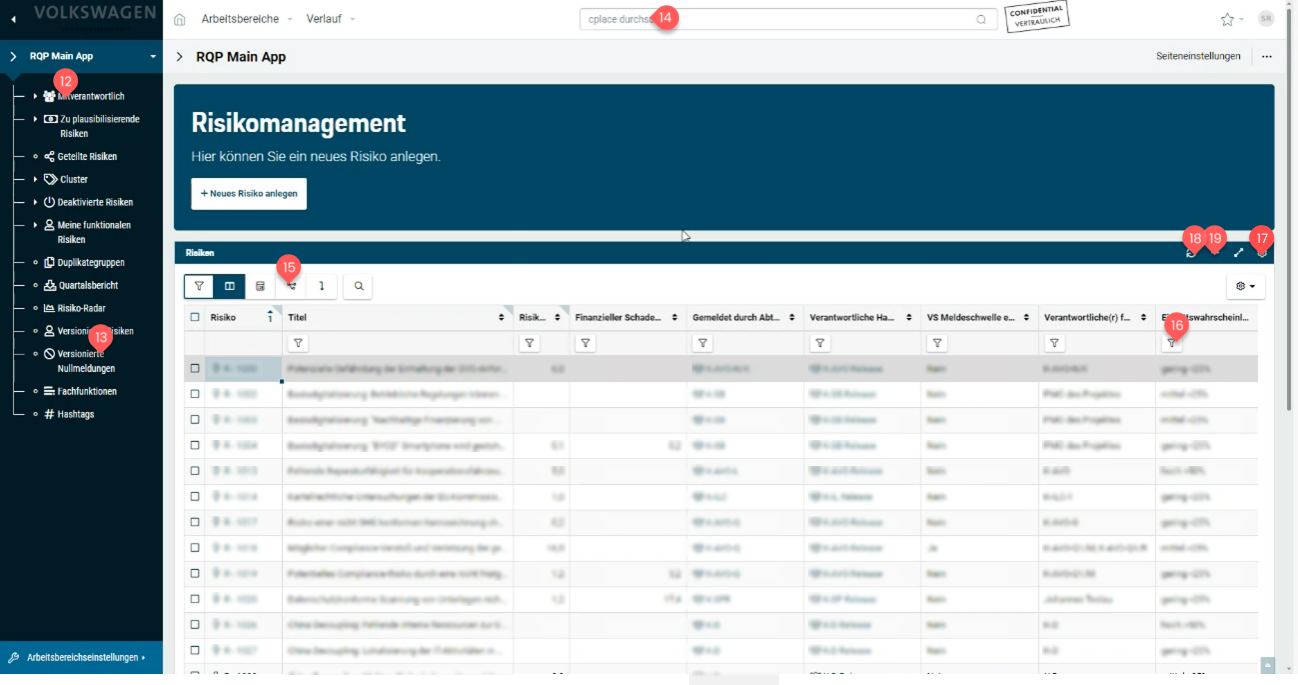
Platform Audit
I analyzed the existing risk management platform to identify usability issues, workflow inefficiencies, and structural complexity impacting clarity and speed.
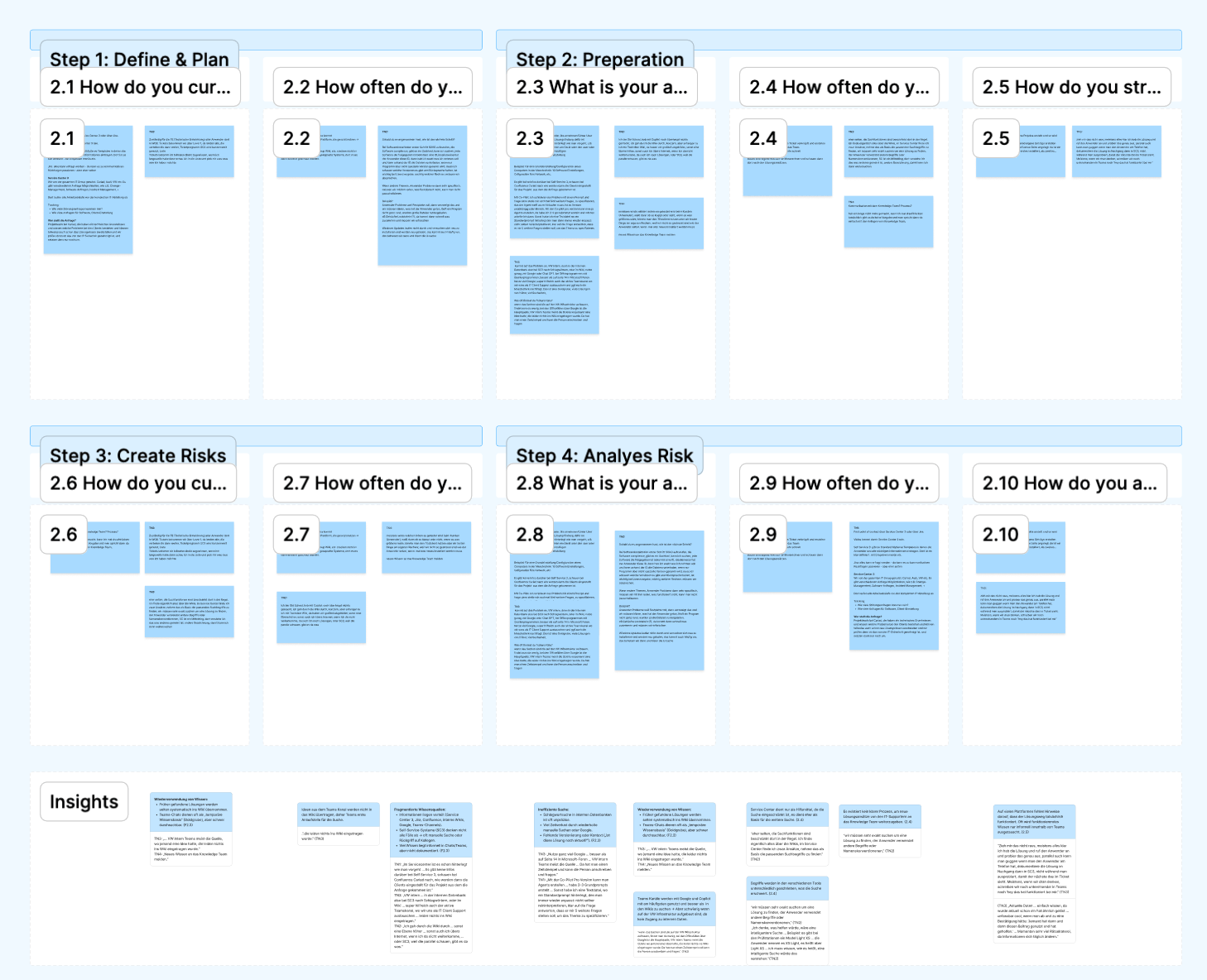
User & Stakeholder Interviews
I conducted interviews with 6+ stakeholders across the risk lifecycle—from operational users creating risks to senior decision-makers validating them—across brands like Audi and VW.
Impact
The research revealed that inefficiencies are not only caused by usability issues, but by a mismatch between workflows, user needs, and perceived value.
Key Insights
- Overemphasis on functional & educational brand communicationVolkswagen’s communication is primarily focused on functional and educational messaging, with
-
Work happens under time pressure and on the goHigh-level users validate risks quickly across contexts—making mobile-first access essential.
The process is perceived as a burden and not a benefitComplexity turns risk management into a mandatory task instead of a value-adding activity.
Core inisght
Complex workflows fail without clear guidanceUsers—especially less experienced ones—struggle to navigate complex processes without clear structure, contextual support, and step-by-step guidance.
Strategic Direction
Goal of the Research Phase
Transform research insights into actionable opportunity areas by identifying pain points, refining the problem, and defining user needs, creating a foundation for ideation and design.
Methods used
→ User Journey Map – visualized end-to-end user experiences, pain points, and needs across roles and process phases
→ Personas & Point of Views– translated research insights into clear user archetypes and problem statements
→ User Flow Diagrams – mapped current and future workflows to identify inefficiencies and optimization potential
→ Opportunity Fields & HMW– reframed insights into actionable opportunity areas and ideation questions
Selected Deep Dive
Deep Dive: From Status Quo to Opportunity
ApproachI created journey maps across key roles and phases of the risk management process to visualize steps, pain points, and user needs. These were validated with stakeholders to ensure alignment. I then developed user flows to map Jobs-to-be-Done and uncover structural inefficiencies. Together, these artifacts formed a shared understanding of the system and laid the foundation for targeted ideation.
Impact
Shifted the focus from isolated usability issues to a systemic understanding of the risk management process—highlighting the need to move from reactive handling to proactive decision-making through improved visibility and guidance.
- Aligned stakeholders on key pain points and process gaps
- Translated complex workflows into clear structures, enabling targeted solution development
Strategic Opportunities
These insights revealed three key opportunity areas to improve efficiency, clarity, and decision-making across the system:
- Frictionless Collaboration FrameworkReduce handover friction and increase transparency by enabling seamless, real-time collaboration across roles and the full risk lifecycle.
- Priority-Driven Workflow OptimizationGuide users toward critical tasks through clear prioritization and contextual support—enabling faster and more informed decisions.
- AI-Augmented Decision SupportLeverage data and AI to support risk evaluation, reduce cognitive load, and guide users through complex decision-making processes.
Concept Development
Goal of the Phase
Translate identified opportunities and user needs into validated design solutions that improve usability, reduce errors, and support efficient risk management across user groups.
Methods used
→ Ideation Sessions - generated solution concepts across UX, features, and navigation
→ Wireframing - structured user flows and interactions to ensure clarity, consistency, and scalability
→ Low & High fidelity Prototypes - iteratively translated concepts into testable designs
→ User Testig - validated concepts and prototypes with users to gather feedback and continuously refine the solution
Selected Deep Dive
Deep Dive: From Ideas to Validated User Experience
Approach
- Facilitated ideation sessions based on user journeys to explore solution concepts
- Translated ideas into structured flows and wireframes
- Developed low- to high-fidelity prototypes using the Design System
- Validated concepts through bi-weekly user testing and continuous iteration
- Delivered high-fidelity designs and handed off in a structured Scrum setup
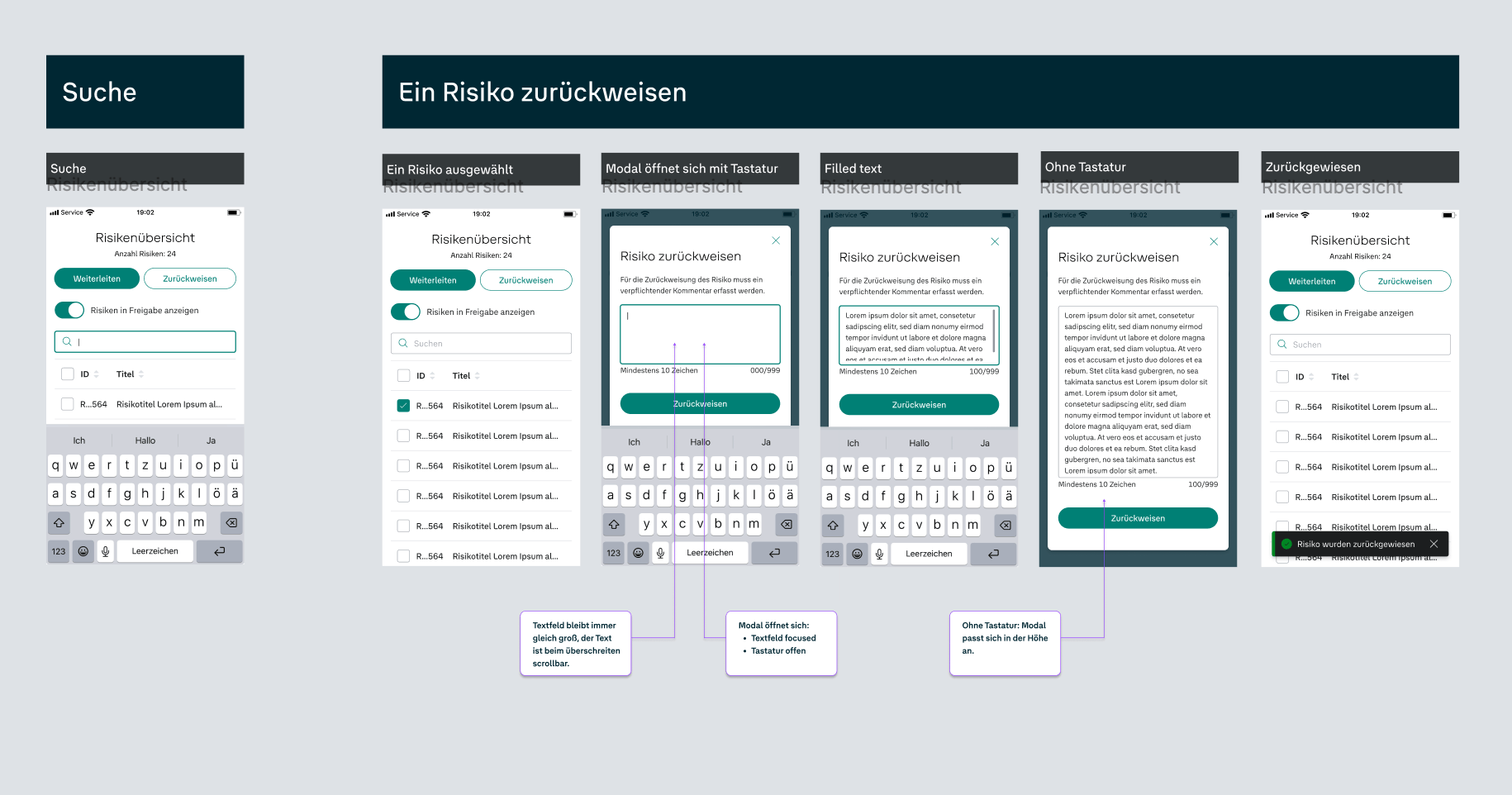
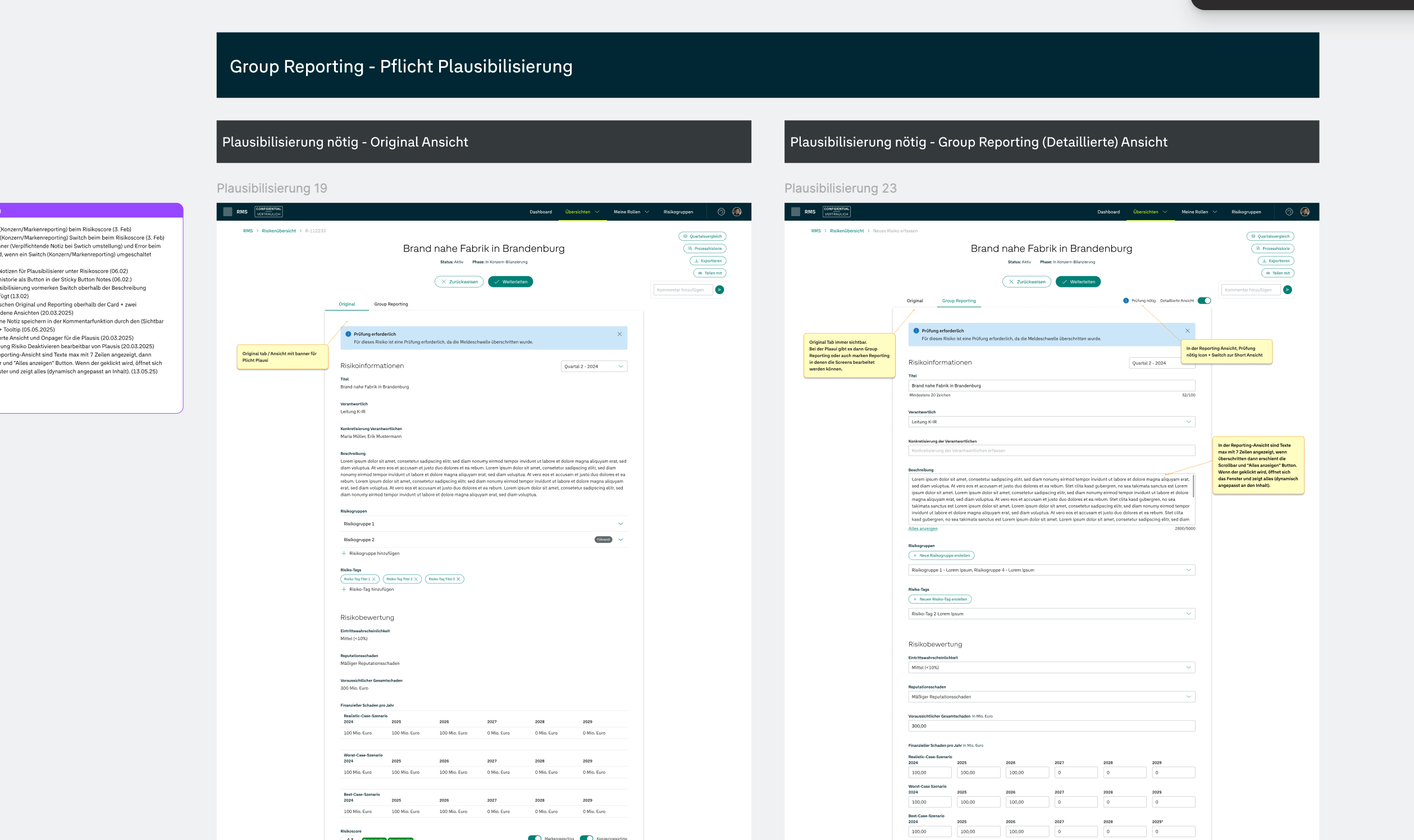
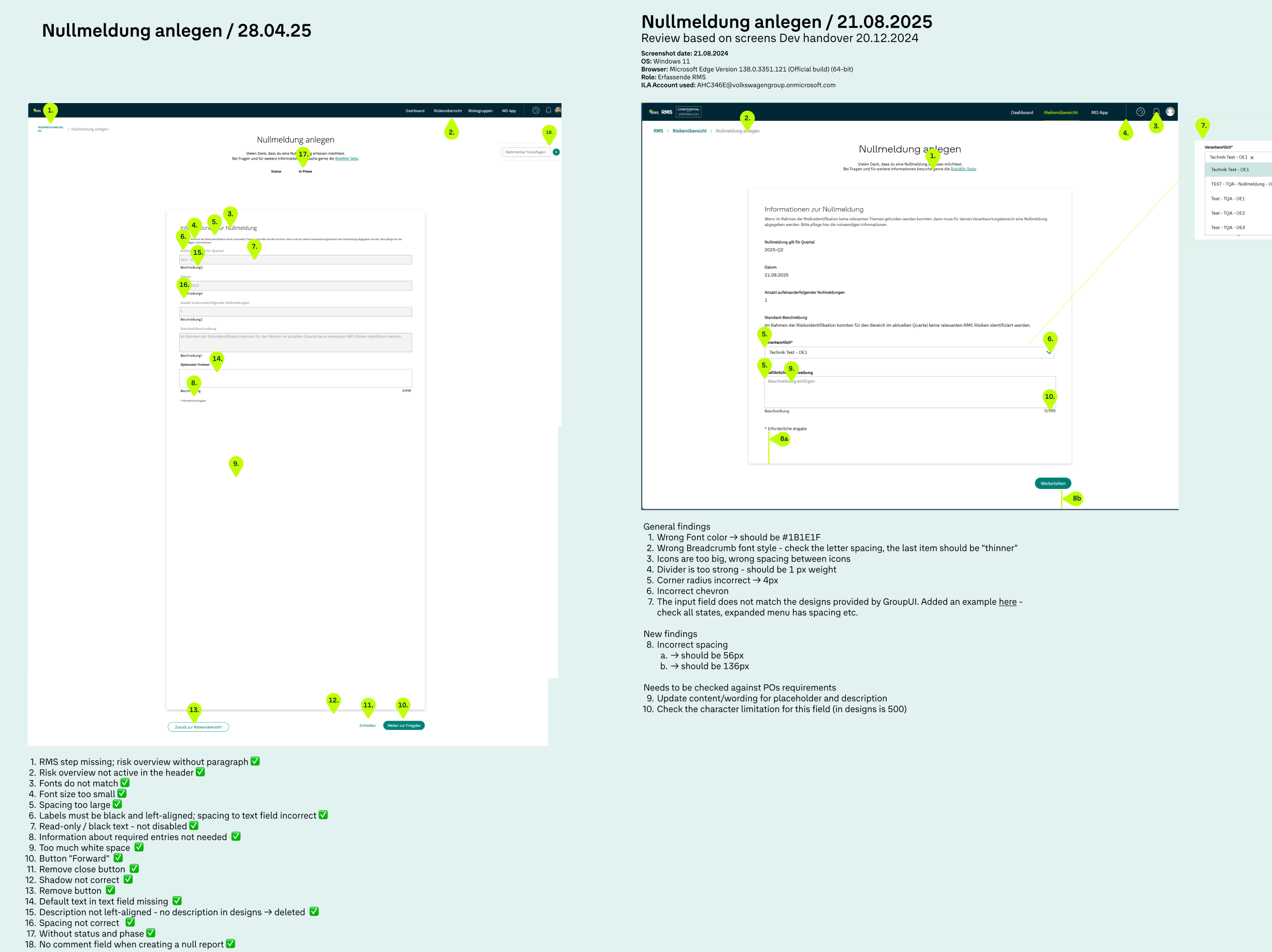
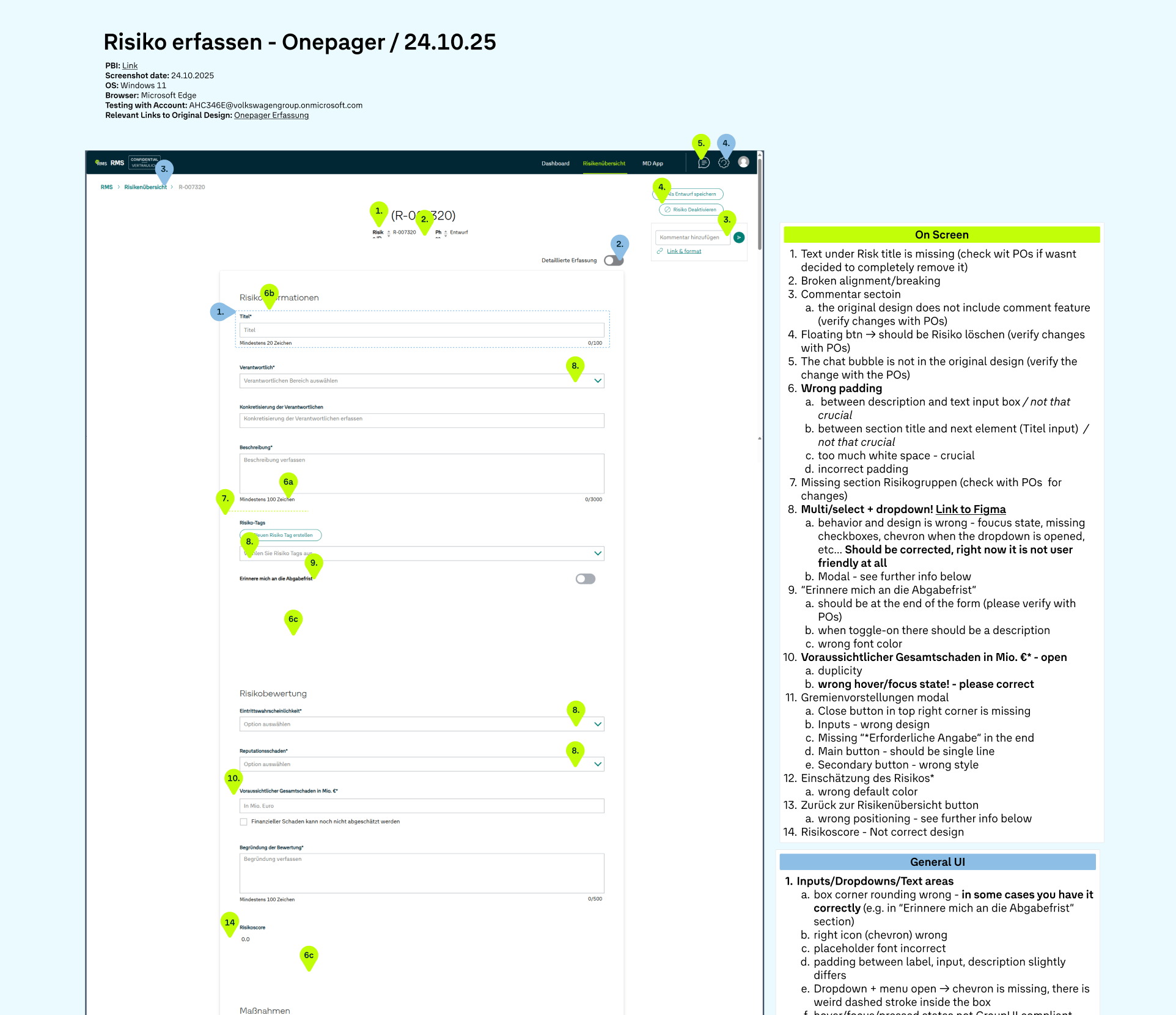
Fig. Screens with Feedback and notes for Dev handover
Impact
Delivered a scalable, user-centered solution by aligning user needs, business goals, and technical constraints through continuous validation.
- Translated concepts into testable solutions through iterative prototyping
- Identified and resolved key usability and workflow issues early
- Extended the Design System to support consistency and scalability
- Established structured Figma documentation and change logs for efficient handover
- Enabled cross-functional alignment and increased confidence in the final solution
The Solution
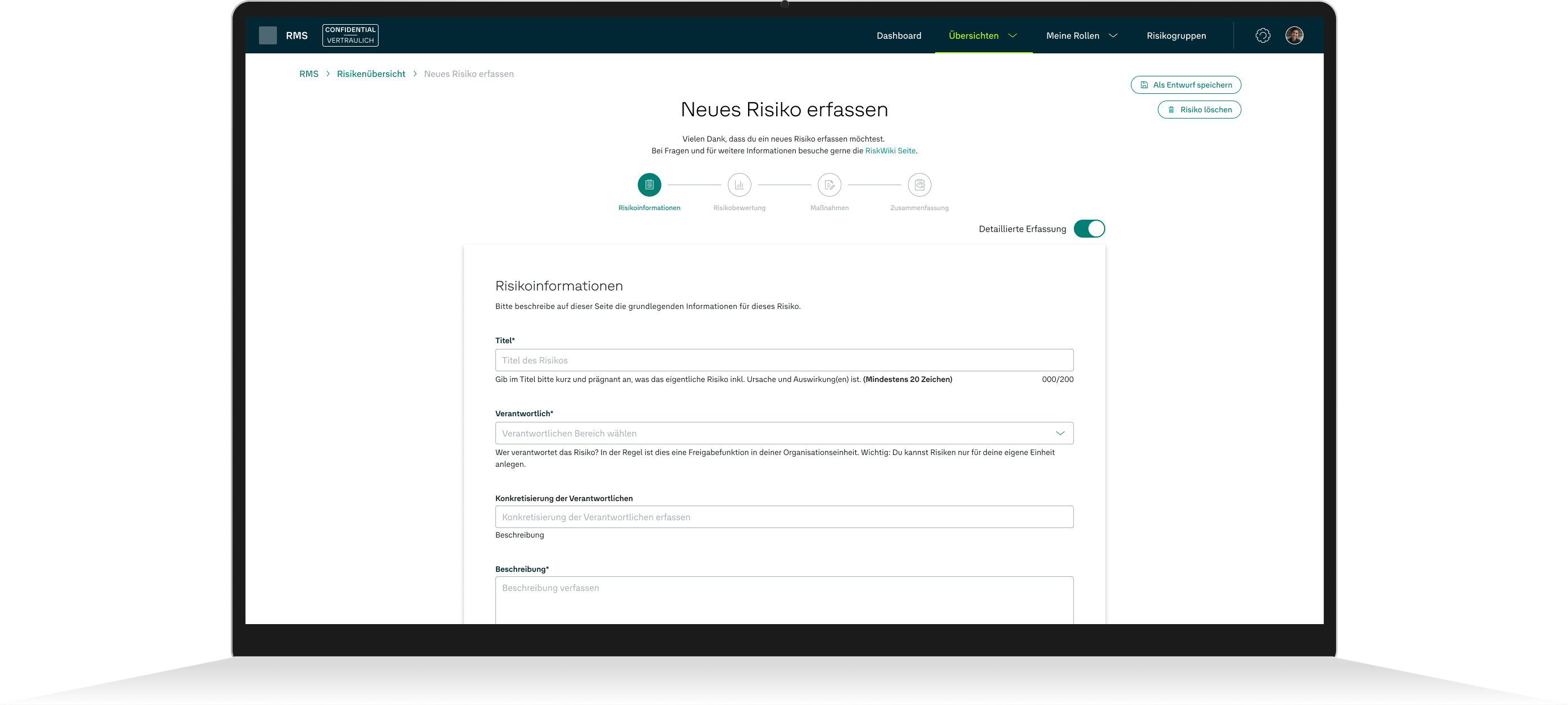
Effortless Creation of Valuable Risks
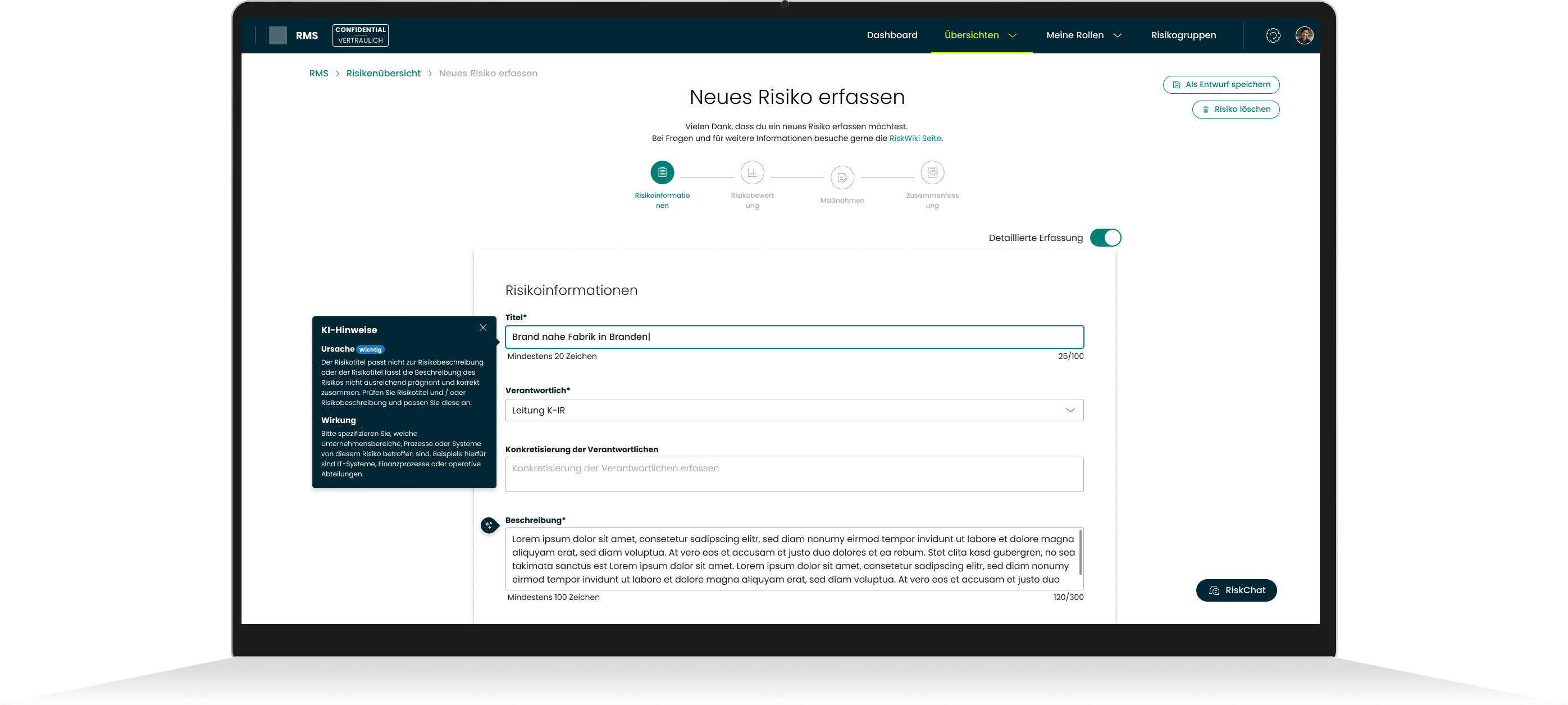
The focus is on empowering users without deep risk management knowledge to create valuable new risk entries.
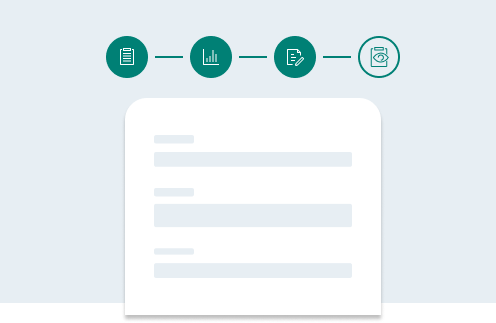
Stepper
Risk regristration in familiar DIN A4 format with editorial checks after each step, an editable summary and option to save drafts which can be send to colleagues.
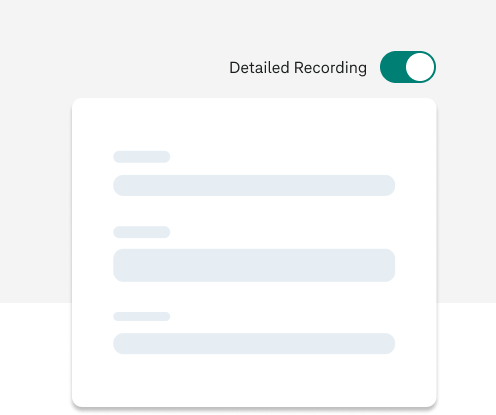
Switch to Detail Mode
Option to switch between a guided step-by-step form with descriptions and links to explanatory videos, and a condensed expert version presented on a single page.
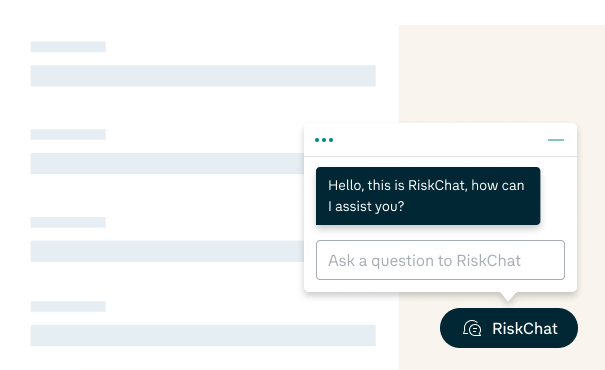
AI-ChatBot
Chatbot connected to internal files and systems to quickly find risk-related information or instructional videos for risk registration.
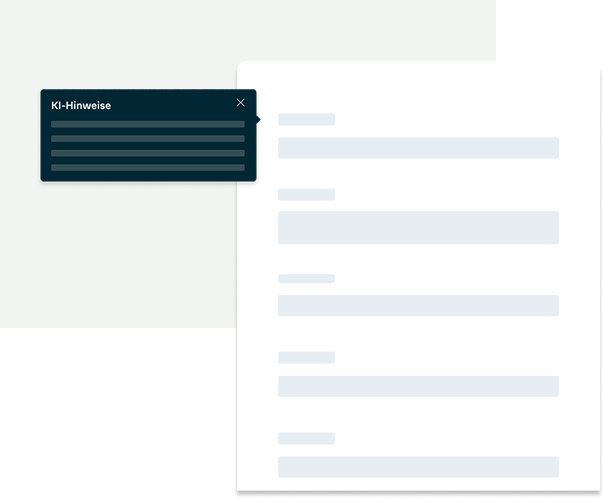
Personalized AI Support
Ability to review a risk registration usig an AI-Editorial-Tool to identify personalized opportunities for each input for improving its quality and logic from the start.
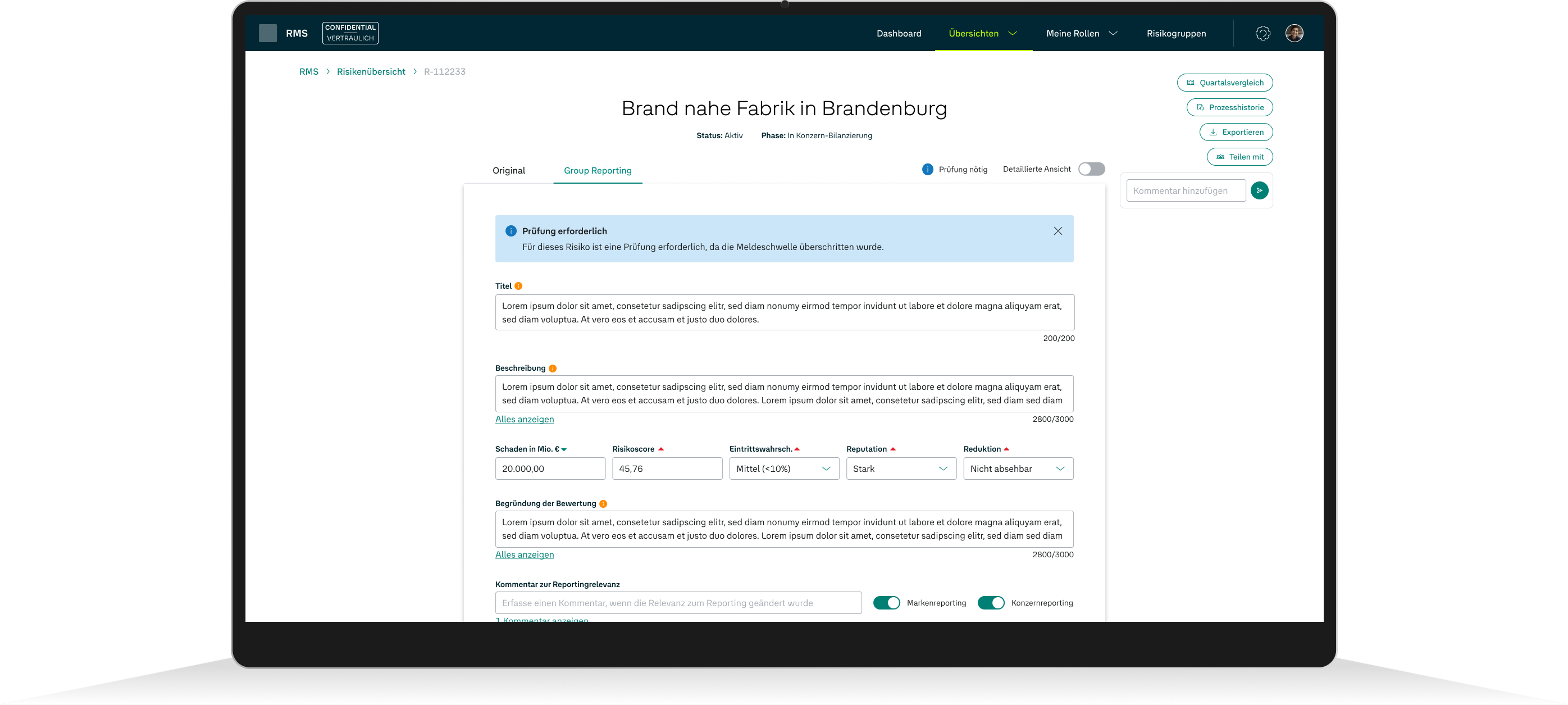
Expert Mode for
Risk Analysis
Condensed desktop mode plus mobile version for simple risk management.
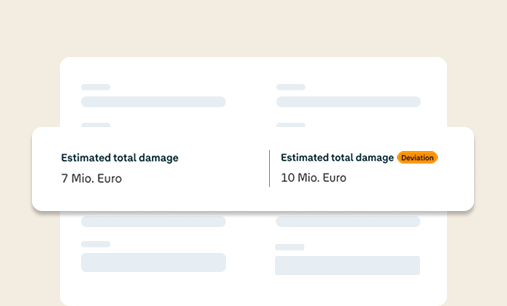
Risk Versions Comparison
Option to compare different risk versions, including older quarterly versions, in a clear and simple way for easier analysis.
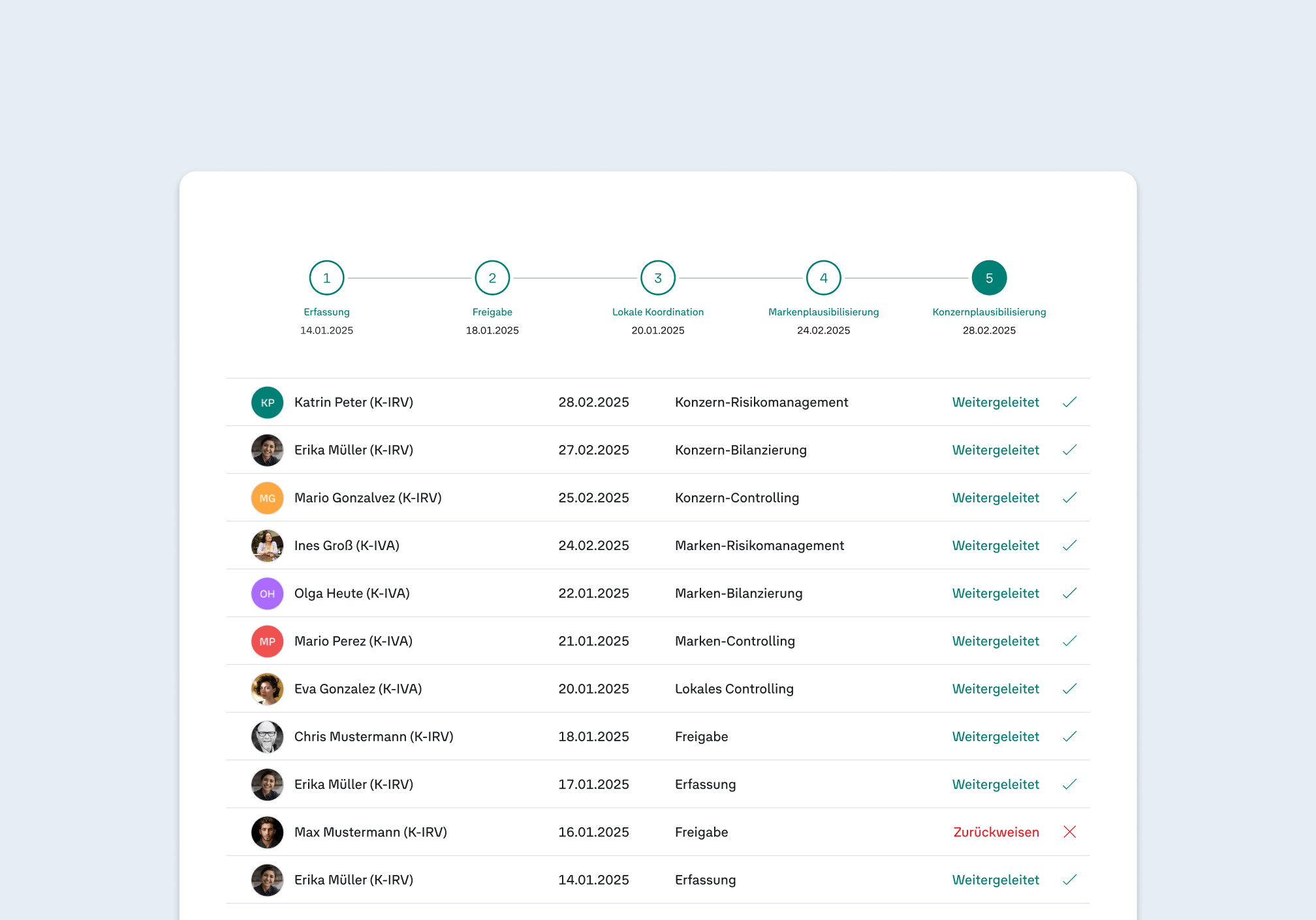
Smart Process History
The process history provides a visual overview of all steps within the risk-management workflow for a specific risk. It clearly shows who made each change with a contact lto reach out easily.
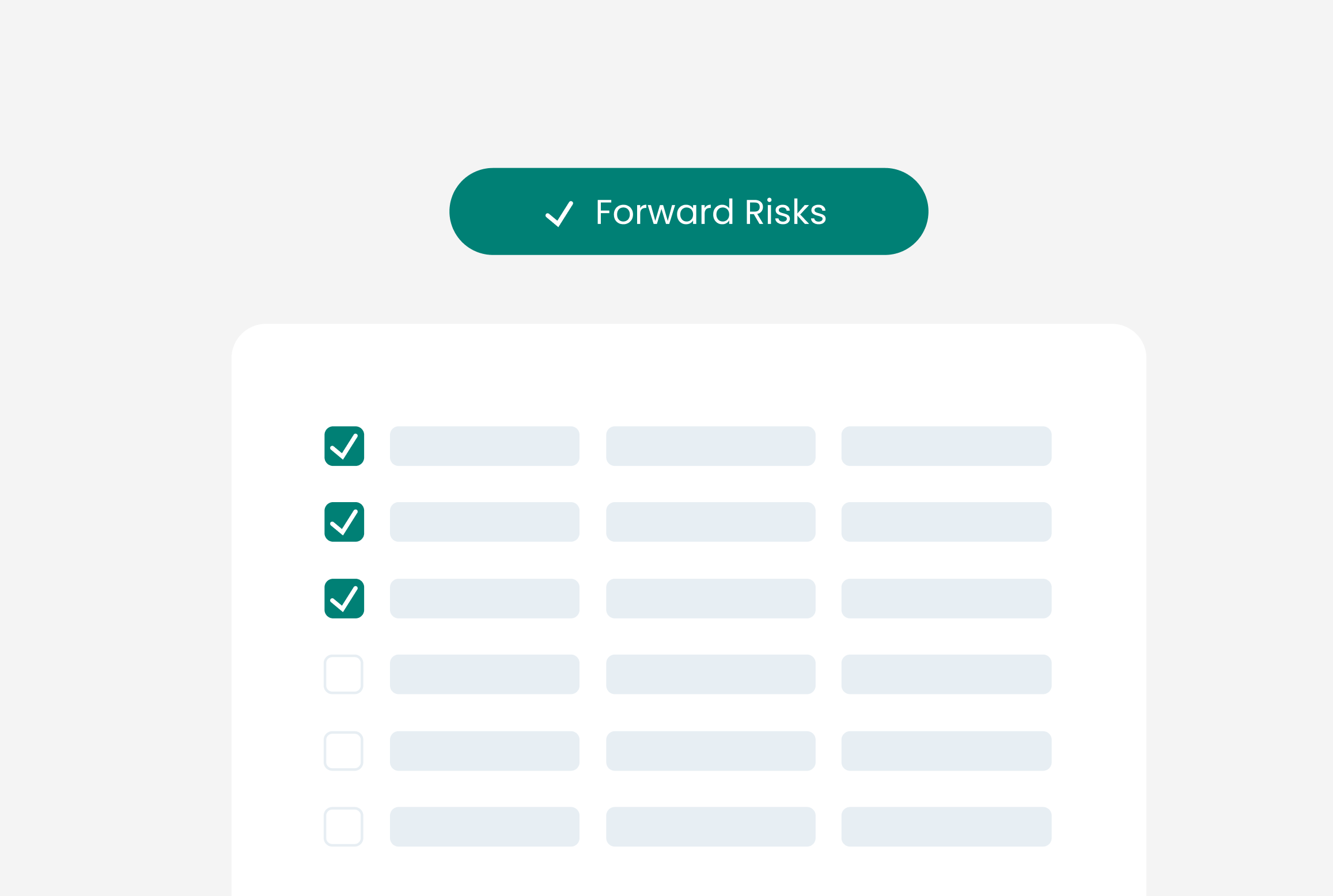
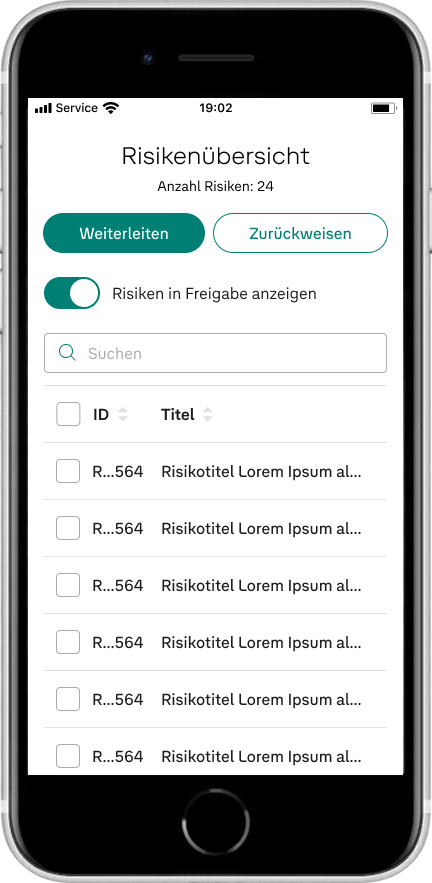
Group Forwarding
Overview of all risks in a list, allowing users to select multiple risks and forward them to the next phase. This list is especially important for the mobile version, enabling quick and efficient forwarding.
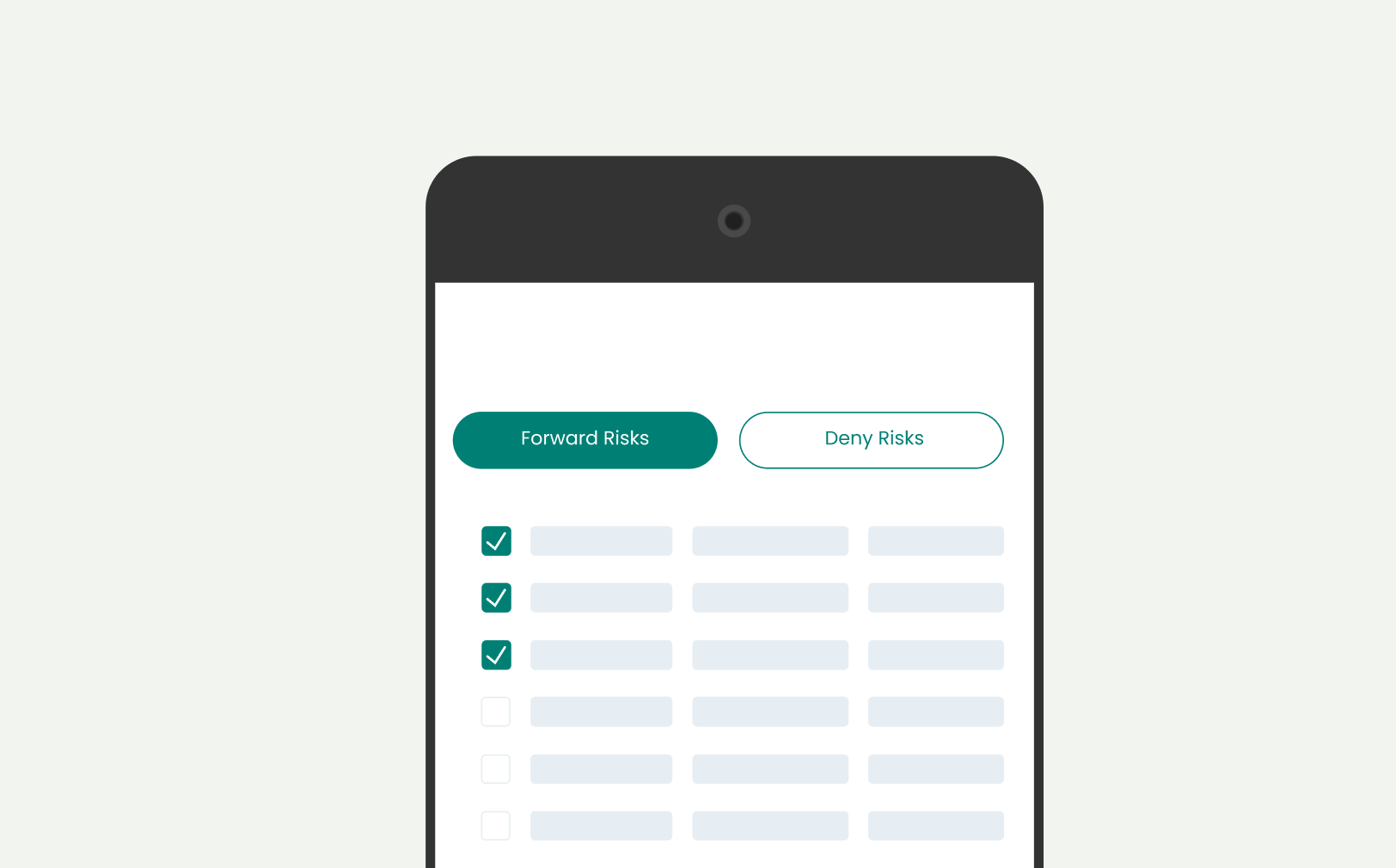
Mobile Version
To enable risk managers to approve or reject risks efficiently, the tool includes a mobile version optimized for the iPhone SE, the most commonly used device in the enterprise
Validation & Delivery
Goal of the Phase
Verify that the product meets all technical, business and user requirements and deliver High-Fidelity Designs for implementation.
Methods used
→Scrum Framework - structured delivery and alignment across design, product, and engineering
→ Design Reviews - ensured implementation quality and consistency with design intent
→ Documentation - defined interactions, edge cases, and specs for development
Selected Deep Dive
Deep Dive: From Design to Implementation
Approach
- I established a structured handover process aligned with Scrum to ensure a smooth transition from design to development.
- Delivered feature-level handovers with fully specified screens, interactions, and edge cases
- Maintained a timestamped change log to track iterations and ensure transparency
- Organized all designs in a dedicated Figma Dev Board, linked to Azure DevOps tickets
- Conducted continuous design reviews during implementation to validate quality and consistency
Impact
Ensured high-quality implementation by aligning design intent with technical execution through a structured and transparent delivery process.
- Reduced ambiguity through clear specifications and documentation
- Maintained consistency between design and implementation
- Enabled efficient collaboration across design, product, and engineering
- Established a scalable handover workflow for future development
Final Impact
- Eliminated the accessibility gapFor expert VW employees by enabling critical workflows on iPhone SE, transforming processes from desk-bound to mobile and ensuring uninterrupted productivity during travel and field operations.
- Cutting Support RequestsReduced user support requests by +50% through a user-friednly experience including the introduction of AI-powered assistance and a guided, step-by-step process—empowering users to resolve issues independently and improving overall efficiency.
Case Study
Transforming Risk
Management
Transformed Volkswagen’s risk management approach - moving from reactive to proactive,
reducing reporting time and improving compliance across global operations.
Context
The Volkswagen Group is facing significant challenges in its risk management process, creating potential financial and operational risks. An internal review revealed that existing platforms are not only ineffective but actively contribute to these issues. With over 600,000 employees and more than 10 brands, the need of an effective risk management system is essential to proactively identify and mitigate risks while ensuring smooth operations and protecting the organization’s reputation.
Project Partner
Volkswagen Group
Duration
+ 9 months
Key Topics
Strategy, UX/UI Design, AI
Role
Consultant & UX Designer
My Role & Process
Design Consultant & UX/UI Designer in a cross-functional team (Product, Engineering):
- Took end-to-end ownership after discovery, leading the solution phase across brands
- Drove design strategy, UX direction, and stakeholder alignment
- Managed close collaboration with the project partner, aligning priorities and decisions
- Operated in a Scrum setup, driving sprint planning, reviews, and iterative delivery
- Led prototyping, user testing, and validation cycles
- Delivered high-fidelity designs with structured developer handover
- Led design reviews to align stakeholders and drive decision-making
Problem Statement
- High Error Rate
Excessive number of support requests by users related to the existing risk management platform.
- Poor visibility of the process
The existing risk quality standards are insufficient and prone to errors.
Challenge
Enhancing risk management processes to achieve greater employee engagement.
Core tension:
- Reduced error rates
- Improve user experience & learnability
Research & Insights
Goal of the Research Phase
Understand weaknesses in risk management workflows and uncover user pain points to inform redesign.
Methods used
→ Existing Platform Audit – analyzed usability, workflows, and system complexity
→ User & Stakeholder Interviews – uncovered needs, behaviors, and decision-making processes
→ Affinity Mapping – identified patterns and insights
Selected Deep Dives
- Undertstanding the Status Quo
Platform Audit
I analyzed the existing risk management platform to identify usability issues, workflow inefficiencies, and structural complexity impacting clarity and speed.
User & Stakeholder Interviews
I conducted interviews with 6+ stakeholders across the risk lifecycle—from operational users creating risks to senior decision-makers validating them—across brands like Audi and VW.
Impact
The research revealed that inefficiencies are not only caused by usability issues, but by a mismatch between workflows, user needs, and perceived value.
Key Insights
- Overemphasis on functional & educational brand communicationVolkswagen’s communication is primarily focused on functional and educational messaging, with limited emotional or immersive brand experiences.
Work happens under time pressure and on the goHigh-level users validate risks quickly across contexts—making mobile-first access essential.
The process is perceived as a burden and not a benefitComplexity turns risk management into a mandatory task instead of a value-adding activity.
Core inisght
Complex workflows fail without clear guidanceUsers—especially less experienced ones—struggle to navigate complex processes without clear structure, contextual support, and step-by-step guidance.
Strategic Direction
Goal of the Research Phase
Transform research insights into actionable opportunity areas by identifying pain points, refining the problem, and defining user needs, creating a foundation for ideation and design.
Methods used
→ User Journey Map – visualized end-to-end user experiences, pain points, and needs across roles and process phases
→ Personas & Point of Views– translated research insights into clear user archetypes and problem statements
→ User Flow Diagrams – mapped current and future workflows to identify inefficiencies and optimization potential
→ Opportunity Fields & HMW– reframed insights into actionable opportunity areas and ideation questions
Selected Deep Dive
Deep Dive: From Status Quo to Opportunity
ApproachI created journey maps across key roles and phases of the risk management process to visualize steps, pain points, and user needs. These were validated with stakeholders to ensure alignment. I then developed user flows to map Jobs-to-be-Done and uncover structural inefficiencies. Together, these artifacts formed a shared understanding of the system and laid the foundation for targeted ideation.
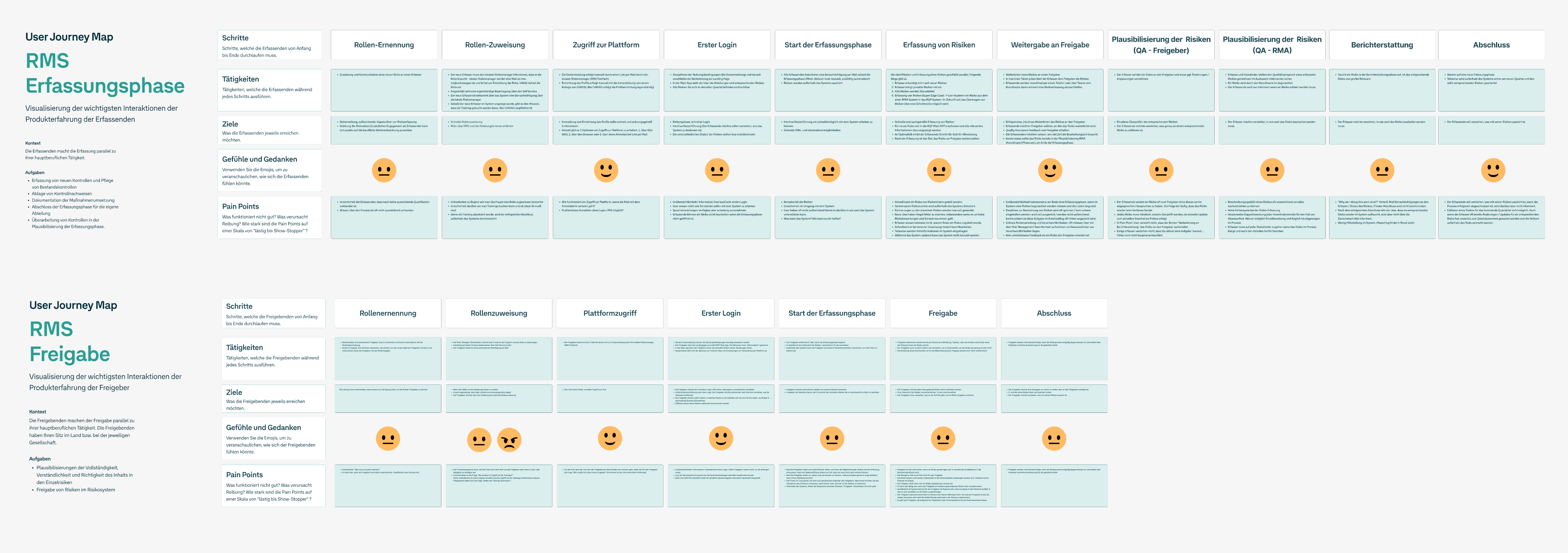
Fig. User Journey Maps
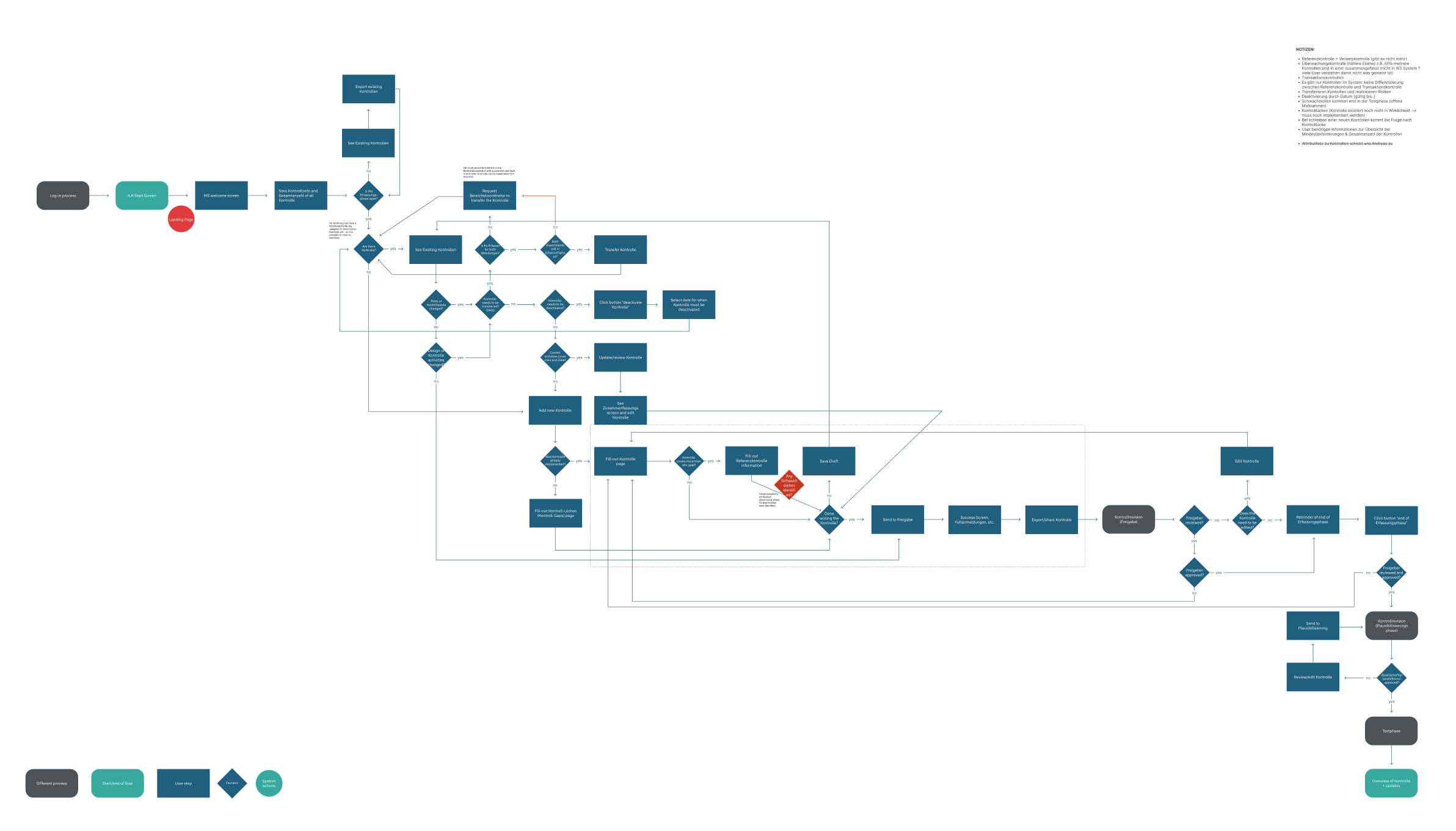
Fig. User Flow Diagrams
Impact
Shifted the focus from isolated usability issues to a systemic understanding of the risk management process—highlighting the need to move from reactive handling to proactive decision-making through improved visibility and guidance.
- Aligned stakeholders on key pain points and process gaps
- Translated complex workflows into clear structures, enabling targeted solution development
Strategic Opportunities
These insights revealed three key opportunity areas to improve efficiency, clarity, and decision-making across the system:
- Frictionless Collaboration FrameworkReduce handover friction and increase transparency by enabling seamless, real-time collaboration across roles and the full risk lifecycle.
- Priority-Driven Workflow OptimizationGuide users toward critical tasks through clear prioritization and contextual support—enabling faster and more informed decisions.
- AI-Augmented Decision SupportLeverage data and AI to support risk evaluation, reduce cognitive load, and guide users through complex decision-making processes.
Concept Development
Goal of the Phase
Translate identified opportunities and user needs into validated design solutions that improve usability, reduce errors, and support efficient risk management across user groups.
Methods used
→ Ideation Sessions - generated solution concepts across UX, features, and navigation
→ Wireframing - structured user flows and interactions to ensure clarity, consistency, and scalability
→ Low & High fidelity Prototypes - iteratively translated concepts into testable designs
→ User Testig - validated concepts and prototypes with users to gather feedback and continuously refine the solution
Selected Deep Dive
Deep Dive: From Ideas to Validated User Experience
Approach
- Facilitated ideation sessions based on user journeys to explore solution concepts
- Translated ideas into structured flows and wireframes
- Developed low- to high-fidelity prototypes using the Design System
- Validated concepts through bi-weekly user testing and continuous iteration
- Delivered high-fidelity designs and handed off in a structured Scrum setup
Fig. Screens with Feedback and notes for Dev handover
Impact
Delivered a scalable, user-centered solution by aligning user needs, business goals, and technical constraints through continuous validation.
- Translated concepts into testable solutions through iterative prototyping
- Identified and resolved key usability and workflow issues early
- Extended the Design System to support consistency and scalability
- Established structured Figma documentation and change logs for efficient handover
- Enabled cross-functional alignment and increased confidence in the final solution
The Solution
Effortless Creation of Valuable Risks
The focus is on empowering users without deep risk management knowledge to create valuable new risk entries.
Stepper
Risk regristration in familiar DIN A4 format with editorial checks after each step, an editable summary and option to save drafts which can be send to colleagues.
Switch to Detail Mode
Option to switch between a guided step-by-step form with descriptions and links to explanatory videos, and a condensed expert version presented on a single page.
AI-ChatBot
Chatbot connected to internal files and systems to quickly find risk-related information or instructional videos for risk registration.
Personalized AI Support
Ability to review a risk registration usig an AI-Editorial-Tool to identify personalized opportunities for each input for improving its quality and logic from the start.
Expert Mode for
Risk Analysis
Condensed desktop mode plus mobile version for simple risk management.
Risk Versions Comparison
Option to compare different risk versions, including older quarterly versions, in a clear and simple way for easier analysis.
Smart Process History
The process history provides a visual overview of all steps within the risk-management workflow for a specific risk. It clearly shows who made each change with a contact lto reach out easily.
Group Forwarding
Overview of all risks in a list, allowing users to select multiple risks and forward them to the next phase. This list is especially important for the mobile version, enabling quick and efficient forwarding.
Mobile Version
To enable risk managers to approve or reject risks efficiently, the tool includes a mobile version optimized for the iPhone SE, the most commonly used device in the enterprise
Validation & Delivery
Goal of the Phase
Verify that the product meets all technical, business and user requirements and deliver High-Fidelity Designs for implementation.
Methods used
→Scrum Framework - structured delivery and alignment across design, product, and engineering
→ Design Reviews - ensured implementation quality and consistency with design intent
→ Documentation - defined interactions, edge cases, and specs for development
Selected Deep Dive
Deep Dive: From Design to Implementation
Approach
- I established a structured handover process aligned with Scrum to ensure a smooth transition from design to development.
- Delivered feature-level handovers with fully specified screens, interactions, and edge cases
- Maintained a timestamped change log to track iterations and ensure transparency
- Organized all designs in a dedicated Figma Dev Board, linked to Azure DevOps tickets
- Conducted continuous design reviews during implementation to validate quality and consistency
Impact
Ensured high-quality implementation by aligning design intent with technical execution through a structured and transparent delivery process.
- Reduced ambiguity through clear specifications and documentation
- Maintained consistency between design and implementation
- Enabled efficient collaboration across design, product, and engineering
- Established a scalable handover workflow for future development
Final Impact
- Eliminated the accessibility gapFor expert VW employees by enabling critical workflows on iPhone SE, transforming processes from desk-bound to mobile and ensuring uninterrupted productivity during travel and field operations.
- Cutting Support RequestsReduced user support requests by +50% through a user-friednly experience including the introduction of AI-powered assistance and a guided, step-by-step process—empowering users to resolve issues independently and improving overall efficiency.
Félix Deraed
Strategic Designer

Berlin, Germany
Currently
Strategic & Experience Designer
at Volkswagen Group Services GmbH

Case Study
Transforming Risk
Management
Transformed Volkswagen’s risk management approach - moving from reactive to proactive,
reducing reporting time and improving compliance across global operations.
Context
The Volkswagen Group is facing significant challenges in its risk management process, creating potential financial and operational risks. An internal review revealed that existing platforms are not only ineffective but actively contribute to these issues. With over 600,000 employees and more than 10 brands, the need of an effective risk management system is essential to proactively identify and mitigate risks while ensuring smooth operations and protecting the organization’s reputation.
Project Partner
Volkswagen Group
Duration
+ 9 months
Key Topics
Strategy, UX/UI Design, AI
Role
Consultant & UX Designer
My Role & Process
Design Consultant & UX/UI Designer in a cross-functional team (Product, Engineering):
- Took end-to-end ownership after discovery, leading the solution phase across brands
- Drove design strategy, UX direction, and stakeholder alignment
- Managed close collaboration with the project partner, aligning priorities and decisions
- Operated in a Scrum setup, driving sprint planning, reviews, and iterative delivery
- Led prototyping, user testing, and validation cycles
- Delivered high-fidelity designs with structured developer handover
- Led design reviews to align stakeholders and drive decision-making


Research
Discovery Phase
Challenge
Impact &
Outcome
Solution Phase
Developement
Synthesis
Concept Development
Solution
Validation
Design & Development
Design
Validation


Focus and Intensity of Work

Problem Statement
- High Error Rate
Excessive number of support requests by users related to the existing risk management platform.
- Poor visibility of the process
The existing risk quality standards are insufficient and prone to errors.
Challenge
Enhancing risk management processes to achieve greater employee engagement.
Core tension:
- Reduced error rates
- Improve user experience & learnability
Research & Insights
Goal of the Research Phase
Understand weaknesses in risk management workflows and uncover user pain points to inform redesign.
Methods used
→ Existing Platform Audit – analyzed usability, workflows, and system complexity
→ User & Stakeholder Interviews – uncovered needs, behaviors, and decision-making processes
→ Affinity Mapping – identified patterns and insights
Selected Deep Dives
- Undertstanding the Status Quo
Platform Audit
I analyzed the existing risk management platform to identify usability issues, workflow inefficiencies, and structural complexity impacting clarity and speed.
User & Stakeholder Interviews
I conducted interviews with 6+ stakeholders across the risk lifecycle—from operational users creating risks to senior decision-makers validating them—across brands like Audi and VW.
Impact
The research revealed that inefficiencies are not only caused by usability issues, but by a mismatch between workflows, user needs, and perceived value.
Key Insights
- Overemphasis on functional & educational brand communicationVolkswagen’s communication is primarily focused on functional and educational messaging, with limited emotional or immersive brand experiences.
Work happens under time pressure and on the goHigh-level users validate risks quickly across contexts—making mobile-first access essential.
The process is perceived as a burden and not a benefitComplexity turns risk management into a mandatory task instead of a value-adding activity.
Core inisght
Complex workflows fail without clear guidanceUsers—especially less experienced ones—struggle to navigate complex processes without clear structure, contextual support, and step-by-step guidance.
Strategic Direction
Goal of the Research Phase
Transform research insights into actionable opportunity areas by identifying pain points, refining the problem, and defining user needs, creating a foundation for ideation and design.
Methods used
→ User Journey Map – visualized end-to-end user experiences, pain points, and needs across roles and process phases
→ Personas & Point of Views– translated research insights into clear user archetypes and problem statements
→ User Flow Diagrams – mapped current and future workflows to identify inefficiencies and optimization potential
→ Opportunity Fields & HMW– reframed insights into actionable opportunity areas and ideation questions
Selected Deep Dive
Deep Dive: From Status Quo to Opportunity
ApproachI created journey maps across key roles and phases of the risk management process to visualize steps, pain points, and user needs. These were validated with stakeholders to ensure alignment. I then developed user flows to map Jobs-to-be-Done and uncover structural inefficiencies. Together, these artifacts formed a shared understanding of the system and laid the foundation for targeted ideation.
Fig. User Journey Maps
Fig. User Flow Diagrams
Impact
Shifted the focus from isolated usability issues to a systemic understanding of the risk management process—highlighting the need to move from reactive handling to proactive decision-making through improved visibility and guidance.
- Aligned stakeholders on key pain points and process gaps
- Translated complex workflows into clear structures, enabling targeted solution development
Strategic Opportunities
These insights revealed three key opportunity areas to improve efficiency, clarity, and decision-making across the system:
- Frictionless Collaboration FrameworkReduce handover friction and increase transparency by enabling seamless, real-time collaboration across roles and the full risk lifecycle.
- Priority-Driven Workflow OptimizationGuide users toward critical tasks through clear prioritization and contextual support—enabling faster and more informed decisions.
- AI-Augmented Decision SupportLeverage data and AI to support risk evaluation, reduce cognitive load, and guide users through complex decision-making processes.
Concept Development
Goal of the Phase
Translate identified opportunities and user needs into validated design solutions that improve usability, reduce errors, and support efficient risk management across user groups.
Methods used
→ Ideation Sessions - generated solution concepts across UX, features, and navigation
→ Wireframing - structured user flows and interactions to ensure clarity, consistency, and scalability
→ Low & High fidelity Prototypes - iteratively translated concepts into testable designs
→ User Testig - validated concepts and prototypes with users to gather feedback and continuously refine the solution
Selected Deep Dive
Deep Dive: From Ideas to Validated User Experience
Approach
- Facilitated ideation sessions based on user journeys to explore solution concepts
- Translated ideas into structured flows and wireframes
- Developed low- to high-fidelity prototypes using the Design System
- Validated concepts through bi-weekly user testing and continuous iteration
- Delivered high-fidelity designs and handed off in a structured Scrum setup
Fig. Screens with Feedback and notes for Dev handover
Impact
Delivered a scalable, user-centered solution by aligning user needs, business goals, and technical constraints through continuous validation.
- Translated concepts into testable solutions through iterative prototyping
- Identified and resolved key usability and workflow issues early
- Extended the Design System to support consistency and scalability
- Established structured Figma documentation and change logs for efficient handover
- Enabled cross-functional alignment and increased confidence in the final solution
The Solution


- Inexperienced Users
- Experienced Users
Effortless Creation of Valuable Risks
The focus is on empowering users without deep risk management knowledge to create valuable new risk entries.
Stepper
Risk regristration in familiar DIN A4 format with editorial checks after each step, an editable summary and option to save drafts which can be send to colleagues.
Switch to Detail Mode
Option to switch between a guided step-by-step form with descriptions and links to explanatory videos, and a condensed expert version presented on a single page.
AI-ChatBot
Chatbot connected to internal files and systems to quickly find risk-related information or instructional videos for risk registration.
Personalized AI Support
Ability to review a risk registration usig an AI-Editorial-Tool to identify personalized opportunities for each input for improving its quality and logic from the start.


- Inexperienced Users
- Experienced Users
Expert Mode for
Risk Analysis
Condensed desktop mode plus mobile version for simple risk management.
Risk Versions Comparison
Option to compare different risk versions, including older quarterly versions, in a clear and simple way for easier analysis.
Smart Process History
The process history provides a visual overview of all steps within the risk-management workflow for a specific risk. It clearly shows who made each change with a contact lto reach out easily.
Group Forwarding
Overview of all risks in a list, allowing users to select multiple risks and forward them to the next phase. This list is especially important for the mobile version, enabling quick and efficient forwarding.
Mobile Version
To enable risk managers to approve or reject risks efficiently, the tool includes a mobile version optimized for the iPhone SE, the most commonly used device in the enterprise
Validation & Delivery
Goal of the Phase
Verify that the product meets all technical, business and user requirements and deliver High-Fidelity Designs for implementation.
Methods used
→Scrum Framework - structured delivery and alignment across design, product, and engineering
→ Design Reviews - ensured implementation quality and consistency with design intent
→ Documentation - defined interactions, edge cases, and specs for development
Selected Deep Dive
Deep Dive: From Design to Implementation
Approach
- I established a structured handover process aligned with Scrum to ensure a smooth transition from design to development.
- Delivered feature-level handovers with fully specified screens, interactions, and edge cases
- Maintained a timestamped change log to track iterations and ensure transparency
- Organized all designs in a dedicated Figma Dev Board, linked to Azure DevOps tickets
- Conducted continuous design reviews during implementation to validate quality and consistency
Impact
Ensured high-quality implementation by aligning design intent with technical execution through a structured and transparent delivery process.
- Reduced ambiguity through clear specifications and documentation
- Maintained consistency between design and implementation
- Enabled efficient collaboration across design, product, and engineering
- Established a scalable handover workflow for future development
Final Impact
- Eliminated the accessibility gapFor expert VW employees by enabling critical workflows on iPhone SE, transforming processes from desk-bound to mobile and ensuring uninterrupted productivity during travel and field operations.
- Cutting Support RequestsReduced user support requests by +50% through a user-friednly experience including the introduction of AI-powered assistance and a guided, step-by-step process—empowering users to resolve issues independently and improving overall efficiency.
Félix Deraed
Strategic Designer
Berlin, Germany
Currently
Strategic & Experience Designer
at Volkswagen Group Services GmbH
